The price of GPU cloud in India now varies significantly.
Indian vendors have H100 pricing around ₹255 per hour, whereas H100 in AWS Mumbai would cost ₹797. This is a significant difference; however, price is just one of three considerations. You will want to get the GPU you need within your deadlines, and also know where you can place your data.
This guide addresses all three considerations based on prices we collected from provider websites on October 9, 2026.
Last updated on October 9, 2026. USD prices assume ₹96.435 per dollar from the RBI on October 6, 2026. Prices in rupees exclude GST.
The AI Compute Threshold Report
We analyzed pricing from 150+ GPU cloud providers to find the exact threshold where an AI startup's OpenAI API bill eclipses the cost of a dedicated H100 cluster.
Read the Full ReportKey takeaways
- Local pricing for H100 is around ₹255 per hour. E2E Networks offers ₹255.55 on demand. Yotta offers ₹356 for one-GPU VMs.
- Long-term commitments drastically reduce costs. E2E Networks offers ₹155.90 for three or more months. Yotta’s two-year bare metal offer comes to ₹253 per GPU.
- The listed price is not a bookable GPU; ensure provisioning as well.
- Under Indian law, it is not mandatory to store AI training data in India. Sectoral regulations and significant data fiduciary classification could make it so.
- The cheapest is IndiaAI at ₹65 per hour, but it is eligibility-based. Expect commercial pricing until IndiaAI accepts your application.
What has changed for GPU cloud in India in 2026
The supply of GPUs in India increased rapidly over the last year.
The IndiaAI Mission announcement by the government talks about a subsidised national GPU pool for startups and research organisations. There was an additional report in March 2026 by PIB on the progress of the GPU pool. EE Times reported a plan for around 20,000 additional GPUs.
The commercial providers did not remain behind either.
Yotta announced a Blackwell Ultra cluster based on the AI CERTs report. We could not verify that the cluster is currently available, so we have listed it under roadmap items. E2E now offers the pricing details of H100, H200, and B200 GPUs on a single pricing page.
Our India GPU provider hub displays the list of GPU providers in India.
We must also consider the rupee. According to Trading Economics, the rupee has depreciated by approximately 8.8% in twelve months. Therefore, a dollar-based GPU would cost more in rupees than before.
GPU cloud India pricing: what providers publish
The providers’ websites provided the prices listed below directly. We consider trackers a secondary source and will indicate them accordingly. The first table presents hourly rates, while the second one shows the cost of a real task.
Both of the major local providers publish their hourly rates. We obtained the E2E rates from its GPU cloud webpage and its public pricing feed. We obtained Yotta rates from its AI Workspace VM webpage and its bare-metal webpage.
| Provider and GPU | Rate per GPU-hour (₹) | Approx. USD | Notes |
|---|---|---|---|
| E2E H100, on demand | ₹255.55 | $2.65 | 26 vCPU, 250 GB RAM; excludes GST |
| E2E H100, spot | ₹70 | $0.73 | Interruptible |
| E2E H200, on demand | ₹379.05 | $3.93 | Excludes GST |
| E2E B200, on demand | ₹664.05 | $6.89 | Excludes GST |
| Yotta 1×H100 SXM VM | ₹356 | $3.69 | 24 vCPU, 240 GB RAM; free ingress and egress |
| Yotta 8×HGX H100 bare metal, monthly | ₹351 | $3.64 | InfiniBand priced separately |
| Yotta 8×HGX B200 bare metal | ₹473 | $4.90 | Per GPU; InfiniBand separate |
| AWS Mumbai p5.4xlarge (1×H100) | about ₹797 | $8.26 | Third-party tracker figure |
| IndiaAI subsidised rate | ₹65 | $0.67 | Approval required |
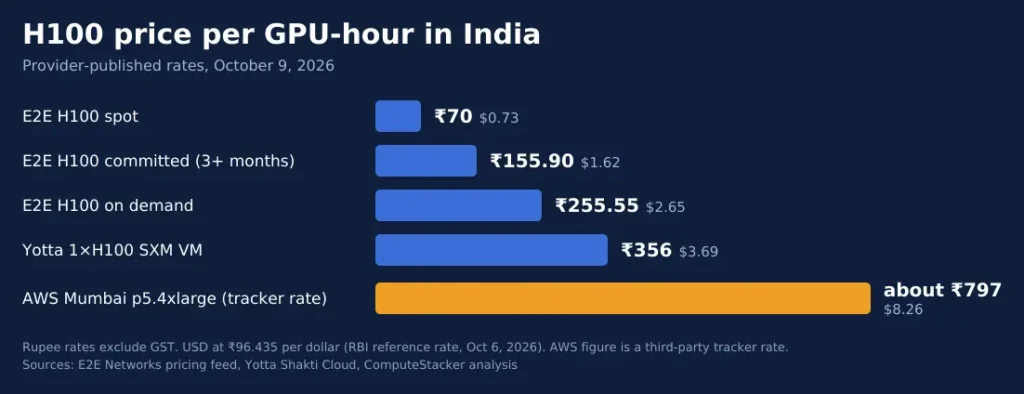
However, the committed term makes a difference. E2E states ₹155.90 per hour for H100 with commitments of three months and above. Yotta reduces its bare-metal H100 price from ₹351 per month to ₹253 per GPU for a two-year commitment.
The smaller and newer GPUs have similar offers. E2E’s pricing feed also mentions A100 80GB at ₹189 on demand and ₹66 on spot, as well as L4 for ₹49. Its H200 spot price is ₹88, and its committed price is ₹189.20 for H200 and ₹290 for B200.
What an 800 GPU-hour run costs
Hourly prices are difficult to evaluate in isolation. Consider a task of 800 GPU-hours of fine-tuning, say eight H100s for 100 hours. The prices shown below are based on table rates and do not include GST.
| Option | Cost in ₹ | Approx. USD |
|---|---|---|
| E2E H100 spot | ₹56,000 | $581 |
| E2E H100 committed | ₹1,24,720 | $1,293 |
| E2E H100 on demand | ₹2,04,440 | $2,120 |
| Yotta 1×H100 VM | ₹2,84,800 | $2,953 |
| AWS Mumbai p5.4xlarge | about ₹6,37,600 | $6,608 |
However, Spot is the most cost-efficient option, but it can stop your run during the process; hence, you have to apply checkpointing. AWS cost is derived from the price of the tracker, so you should check it out on the console. The difference between spot and AWS is as much as 11 times.
In comparison, let us talk about global neoclouds. Our analysis of H100 costs demonstrates that Lambda’s cost is $3.99 and Nebius is $4.50. All the above costs are higher than the E2E on-demand price.
Be careful with older prices.
Third-party web sources keep providing H100 costs ranging from ₹350 to ₹400. However, these costs are outdated. E2E pricing feed, created on October 8, 2026, provides the cost of ₹255.55.
Why GPU prices vary between providers
The headline rate per hour doesn’t reveal multiple distinctions. Each one could shift your true price by a larger margin than the difference between two providers.
- Packed resources. The H100 rate at E2E offers 26 vCPUs along with 250 GB of RAM. Make sure to compare what’s included in the quotes.
- Network fees. Yotta offers free ingress and egress on its VM. Other hyperscalers might be charging for data egress from their networks.
- Interconnect. Yotta bills InfiniBand connections separately for bare-metal clusters. It is required for multi-node training.
- Taxes. Both providers quote rates excluding GST. Don’t forget to add them up while estimating.
Our article on hidden GPU cloud prices discusses these line items in more detail. If you find pricing tables confusing, begin by reading our article on how to interpret a GPU pricing page.
Can you actually get the GPU you need?
The price tag is not a guarantee of the GPU. There are five stages of capacity, and a provider may be at any of them. This is the ladder we apply when analysing providers:
- Advertised. The provider includes the GPU on their website or in a press release.
- Listed. The GPU is available on a pricing page with a rate.
- Available. The console displays inventory for your region.
- Provisionable. You can spin up an instance today without a sales call.
- Sustained. You can sustain this capacity for weeks of training.
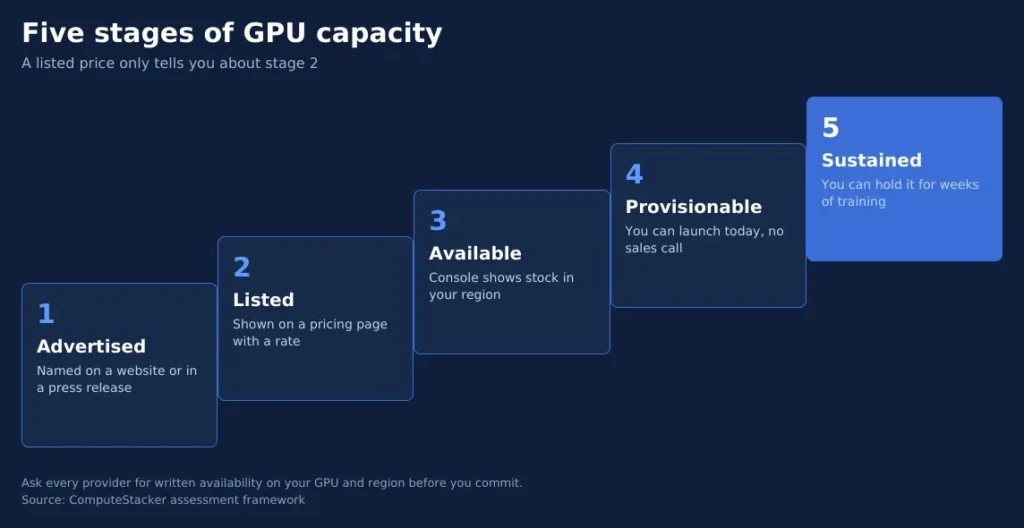
E2E has “Contact Sales” instead of rates for their monthly and yearly plans. It means there is a difference between listed and sustained capacity with larger commitments. Yotta’s Blackwell Ultra announcement is at the advertised stage for us until it gets a booking page.
Our analysis of the GPU capacity crunch helps to understand why the stock becomes scarce in case of increased demand. Always ask providers for written availability of the targeted GPU and region.
Data residency: does your GPU have to be in India?
The answer for most organisations is no, but regulated industries are the exception.
The Digital Personal Data Protection Act is less stringent than the localisation requirements that some customers fear. Section 16 allows transfers to any nation other than those on the government’s negative list.
The PIB DPDP publication outlines a phased approach. Up to September 2026, there is no nation on the negative list.
Rule 13 creates an exception for significant data fiduciaries.
The government can mandate the storage of certain personal data within India by such organisations. The Mondaq article on the rule discusses the process of designation. Contact a lawyer for guidance if your organisation may fall into this category.
Data residency rules by industry
The DPDP Act provide the general rule. Sector regulators overlay more stringent rules. The following table shows the main ones that affect GPU cloud consumers.
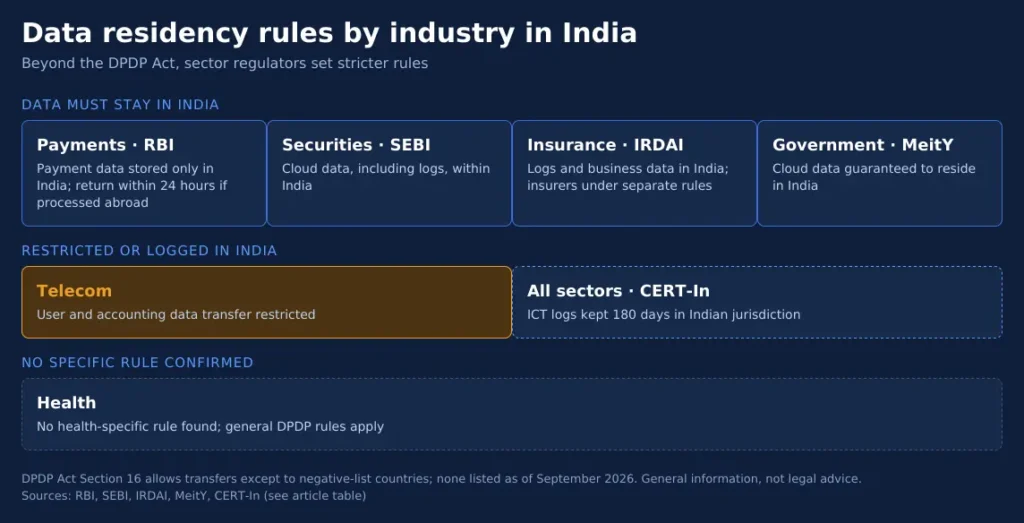
| Sector | What the rule requires | Source |
|---|---|---|
| Payments (RBI) | Payment system data must sit only in India. Processing abroad is allowed, but the data must return and be deleted abroad within one business day or 24 hours, whichever is earlier. | RBI storage FAQ, April 2018 circular |
| Securities (SEBI) | Regulated entities must keep cloud data, including logs, within India’s legal boundaries. This covers primary and disaster-recovery sites. | SEBI cloud framework, March 2023 |
| Insurance (IRDAI) | Regulated entities other than insurers must store ICT logs, critical data and business data in India. Insurers keep primary data in India under separate IRDAI rules. | IRDAI cyber guidelines, April 2023 |
| Telecom | The Unified License restricts transfer of user and accounting information outside India, with limited exceptions. | Unified License report, 2013 |
| Government | Government departments using cloud must keep data in India. Empanelled providers guarantee this in their terms. | MeitY cloud guidelines, April 2017 |
| Health | We found no health-specific localisation rule. The DISHA bill appeared only as a draft in our source, so the general DPDP rules apply. Confirm with counsel. | Health data overview, January 2023 |
| All sectors (CERT-In) | Service providers and data centres must keep ICT logs for a rolling 180 days within Indian jurisdiction. Incidents need reporting within 6 hours. | CERT-In directions summary, April 2022 |
Payment systems, securities, insurance, and governmental activities have the most stringent regulations. If any of them apply to you, use an Indian data centre for computing, storage, and backups.
The overwhelming majority of the sectoral regulations also refer to logs, not only customer data. That is why the following questions will refer to the logs and access to support services.
The CERT-In regulation concerning logs is the only regulation from the list that applies to all sectors. It regulates service providers and data centres; hence, find out how your provider maintains its logs.
This chapter contains general information, and not legal advice. Please consult a lawyer before using it.
What residency covers in practice
Residency laws pertain only to personal data, not to all the data bytes you process. Model weights, publicly available data, and synthetic data do not qualify under residency rules. Customer data, health data, and financial data usually qualify for residency laws, and sector regulators add their own rules, as the table above shows.
Indian customers choose an Indian provider for latency and rupee billing, rather than for legal reasons.
Some Indian customers choose an Indian provider because it is a requirement in a procurement contract. E2E has Delhi-NCR and Chennai. Yotta has Navi Mumbai and Greater Noida.
Questions to ask a provider about residency
Answers in words are better than marketing copy. Make sure to ask each provider these questions before you commit:
- Where is the data stored? Request the city of the data centre for computing, storage, and backups.
- Where are logs and access for support processed? Operational data may travel abroad even when the GPU doesn’t.
- Does the agreement include the location? This is important information that procurement departments often require in writing.
- What if the requirements change? Find out what the provider will do to relocate you if there is a negative list.
IndiaAI vs commercial GPU clouds
IndiaAI’s subsidies reduce the cost of GPUs to just ₹65 per hour or $0.67.
This is much lower than any commercial cost shown in the table above. But there is a catch: you have to apply and hope for the best.
Commercial clouds provide the advantage of speed and security. You register, make payments, and begin. IndiaAI provides you with cheap pricing, but you will have to wait for approval of your project.
It makes perfect sense to divide your usage on both fronts. Utilise IndiaAI for your research projects while using the commercial cloud for productive work.
India vs global GPU clouds
Global neoclouds still have deep inventories and mature tools. Local providers are cheaper in rupee terms and have Indian data centres. Hyperscalers come on top of the price list but provide managed services.
AWS now provides a single-GPU H100 instance in Mumbai via the p5.4xlarge instance, which was launched in August 2025 and supports SageMaker. It is priced at around ₹797 per hour, according to the tracker, which is thrice the on-demand price of E2E. Check out the price on the AWS Console since trackers are behind.
Our neocloud vs hyperscaler TCO comparison highlights when the premium is worth it. For a more comprehensive look at the hyperscalers, check out AWS, GCP, and Azure compared. For a regional perspective, check out the Australia GPU Cloud Guide.
Which option fits which workload
Different jobs benefit from different configurations. This table of recommendations clearly indicates this simple match.
- Tuning & Experimentation: E2E on-demand H100s or H100 Spot saves on costs. Check regularly in case you opt for Spot.
- Consistent inference: having a dedicated term of service reduces hourly rates. Both E2E three-monthly rates and Yotta long-term bare-metal agreements fit.
- Training on multiple nodes: Yotta’s 8×HGX bare-metal nodes fit here. Add InfiniBand costs on top of the GPU price.
- Data-intensive applications: find a supplier whose data centre location and agreement terms comply with your legal opinion.
- Managed ML platforms: AWS SageMaker in Mumbai is perfect for organisations who prioritise functionality over prices.
How to choose a GPU cloud in India
Proceed with these steps in sequence.
- Pick up the GPU first. Make sure you pick a GPU with appropriate capacity for your model. Here are tips for picking your GPU, and here are our H100 provider pages along with current prices.
- Calculate hours. Multiply total GPUs x run time. Here’s everything you need to know about what a GPU hour is all about.
- See if your utilisation is high enough. Idling GPUs cost you money. See why utilising the GPUs matters more than the number of GPUs that are purchased.
- Set your residency policy. Consult your lawyers to make sure whether personal data needs to be processed in India only.
- Provision a test instance. Launch a trial instance before purchasing a full-scale committed term.
- Negotiate commitment period. E2E’s commitment pricing sits about 39% lower than the on-demand price point. Yotta’s two-year pricing stands 28% below its monthly on-demand price.
For budget estimates in training models, see this guide on the cost to train an AI model.
For your GPU choice, see the top GPUs for training large language models.
Also, don’t miss out on this E2E Networks’ guide.
FAQ
How much does E2E charge for a monthly or annual H100 plan?
E2E does not disclose these prices. They provide “Contact Sales” on their pricing page for the monthly and annual terms. The only rate disclosed is ₹155.90 per hour for three months or more.
Does Yotta publish its GPU prices?
Some articles suggest that Yotta provides prices upon request only. On its website, there is ₹356 per hour for a single H100 VM. There are ₹105 per hour per GPU for its bare metal offerings.
Does E2E offer spot GPUs?
Yes. The spot price for E2E H100 is ₹70 per hour, and for E2E H200, it is ₹88 per hour. Since spot computing resources can end unexpectedly, use them for fault-tolerant applications only.
Do these prices include GST?
Both cloud providers provide rupee prices before the Goods and Services Tax. We could not find the GST rate for GPU cloud services, so get a tax-inclusive quote from each provider.
How often do these prices change?
The E2E pricing feed had the following timestamp: October 8, 2026. They update their rates dynamically. There are still some old versions floating around; hence, please cross-check on the website when you make the purchase. The depreciation of the rupee also affects the USD prices that appear in our tables since we use a constant exchange rate.
Can I rent multiple GPUs in one node?
Yes. Yotta offers 8×HGX H100 and 8×HGX B200 bare metal nodes. InfiniBand connectivity might incur an extra charge when spanning across nodes.
Conclusion
India’s GPU cloud pricing has become transparent enough for comparison. The local service vendors provide cheaper services in rupees compared to the hyperscalers, while committed pricing models reduce expenses even more. The residency law is not as stringent as many buyers believe, although industry regulations are in place.
Select the required GPU first, then make sure that the vendor will offer it. Explore the entire list in our India GPU cloud provider directory.
Get personalised, no-commitment quotes from top AI infrastructure providers in under 2 minutes.