The Default Choice vs. The Smart Choice
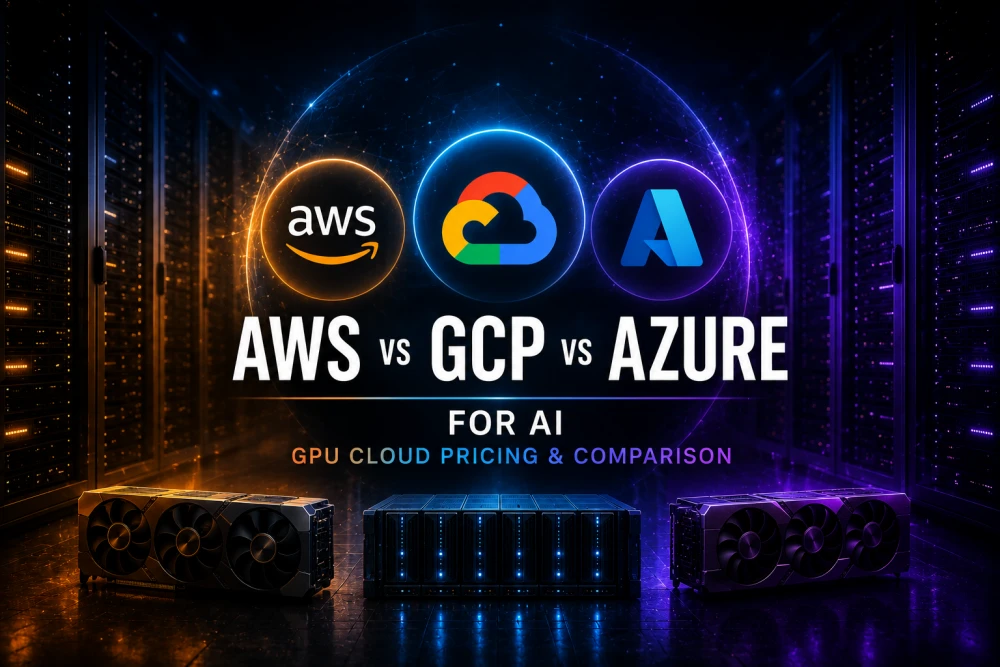
When the board of directors asks a CTO about their AI infrastructure strategy, the safest answer is usually a three-letter acronym: AWS, GCP, or Azure. These “Hyperscalers” have dominated the enterprise cloud computing market for over a decade. They are the incumbent titans, offering everything from basic virtual machines to complex satellite data processing algorithms.
However, the artificial intelligence boom—specifically the demand for high-end NVIDIA GPUs—has exposed a structural vulnerability in the hyperscaler model. While they offer unparalleled reliability and ecosystem integration, they also levy massive premiums, impose crippling egress fees, and suffer from severe hardware shortages. Choosing a hyperscaler for AI compute is no longer the automatic default; it is a calculated architectural decision.
The Hyperscaler Landscape
The “Big Three” control the vast majority of enterprise AI workloads:
- Amazon Web Services (AWS): The behemoth. Offers P4 (A100) and P5 (H100) instances, alongside their proprietary Trainium and Inferentia chips. Known for its massive ecosystem (SageMaker, Bedrock).
- Google Cloud Platform (GCP): The AI pioneer. Offers A3 (H100) VMs and their proprietary Tensor Processing Units (TPUs). The creators of Kubernetes and TensorFlow, GCP is often favored by hardcore ML research teams.
- Microsoft Azure: The OpenAI partner. Azure ND H100 v5 series instances are highly sought after. They offer the most seamless integration with OpenAI’s models for enterprise compliance.
When to Choose a Hyperscaler
Despite the high costs, there are scenarios where choosing a hyperscaler is unequivocally the right decision:
The AI Compute Threshold Report
We analyzed pricing from 150+ GPU cloud providers to find the exact threshold where an AI startup's OpenAI API bill eclipses the cost of a dedicated H100 cluster.
Read the Full Report- Enterprise Compliance and Auditing: If you are a bank, healthcare provider, or government contractor, your entire infrastructure must meet stringent compliance standards (FedRAMP, PCI-DSS, HIPAA). Hyperscalers provide out-of-the-box compliance that independent GPU clouds cannot match.
- Monolithic Architectures: If your massive data lake (exabytes of data) is already sitting in Amazon S3, moving it to an independent GPU cloud for training will bankrupt you via egress fees. You must bring the compute to the data, which means renting AWS GPUs.
- Startup Credits: Many AI startups receive $100,000+ in free hyperscaler credits via accelerator programs (like Y Combinator). When the compute is free, the hyperscaler is always the right choice—until the credits run out.
The Core Benefits: Ecosystem and Reliability
The primary advantage of hyperscalers is their exhaustive ecosystem. Building an AI application isn’t just about GPUs. You need managed Kubernetes (EKS/GKE) for orchestration, identity and access management (IAM) for security, virtual private clouds (VPCs) for networking, and managed databases for vector storage.
Hyperscalers provide this entire stack under a single pane of glass, with a unified billing structure. Furthermore, their Service Level Agreements (SLAs) guarantee 99.99% uptime. If a server rack catches fire in an AWS availability zone, your workload automatically fails over to another zone without you ever noticing.
The Demerits: The Egress Trap and Availability Quotas
The biggest criticism of hyperscalers in the AI era is the “Premium Tax.” Renting an H100 instance on AWS or GCP is typically 40% to 60% more expensive than renting the exact same hardware from a specialized GPU cloud (like CoreWeave or Lambda).
Worse are the Egress Fees. Hyperscalers charge exhorbitant rates to move your data out of their cloud. This is a deliberate strategy to create vendor lock-in. Once your terabytes of training data are in AWS, the cost to move them to a cheaper competitor is often higher than simply staying and paying the AWS premium.
Finally, there is the issue of availability. Try spinning up an on-demand H100 instance on AWS today. You will likely be met with an “insufficient capacity” error. Hyperscalers reserve their best GPUs for enterprise clients willing to sign multi-million dollar, multi-year commitments. For agile startups, getting GPU quota is notoriously difficult.
Feature Breakdown: Enterprise-Grade Networking
When training massive foundational models (like GPT-4), a single GPU is not enough. You need thousands of GPUs working in parallel. The bottleneck is no longer the GPU itself, but the network connecting them.
Hyperscalers excel at high-performance networking. AWS utilizes Elastic Fabric Adapter (EFA), while Azure and GCP use NVIDIA’s InfiniBand networks capable of 400Gbps to 800Gbps node-to-node bandwidth. Without this enterprise-grade networking infrastructure, distributed training is impossible.
Pricing Dynamics: The Commitment Game
Hyperscaler pricing is designed to punish on-demand usage and reward long-term planning. If you pay hourly (on-demand), you pay the absolute maximum rate. To achieve reasonable unit economics, you must purchase 1-year or 3-year Reserved Instances (RIs) or Compute Savings Plans.
This requires significant upfront capital (often paid entirely in advance) and accurate capacity forecasting. If you reserve 100 GPUs but only use 50, you are still paying for 100.
Conclusion: The Enterprise Safety Net
Hyperscalers are not the cheapest option, nor are they the most flexible. But they are the safest. For enterprises where a security breach or an hour of downtime costs millions of dollars, the hyperscaler premium is simply viewed as an insurance policy. For everyone else, they represent a powerful, albeit expensive, ecosystem that must be navigated with caution.
Get personalised, no-commitment quotes from top AI infrastructure providers in under 2 minutes.