The Developer’s Dilemma: Coding vs. DevOps
The artificial intelligence revolution has democratized access to state-of-the-art models, but it has simultaneously introduced a massive infrastructure headache. Deploying a Large Language Model (LLM) like LLaMA-3 or Mixtral into production is not as simple as running a Python script. It requires managing complex GPU memory states, configuring Triton inference servers, handling concurrent request batching via vLLM, and constantly monitoring GPU thermal limits
For 90% of startups, indie hackers, and agile enterprise teams, spending weeks configuring Docker containers and CUDA drivers is an unacceptable distraction from their core product. This is where Managed Inference APIs (also known as Serverless GPUs or Inference-as-a-Service) enter the equation, offering the holy grail of modern software development: massive scale with zero DevOps.
What is Managed Inference?
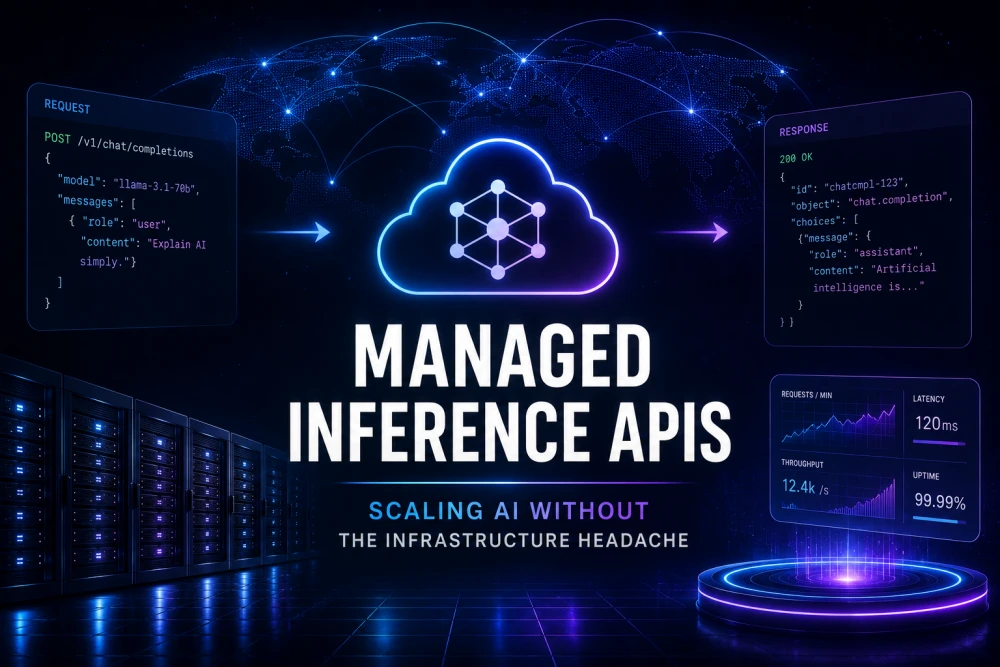
Managed Inference providers abstract away the physical hardware layer completely. Instead of renting a server, you send a JSON payload via an HTTP POST request to an endpoint, and the provider returns the model’s output. The most famous example is OpenAI’s API, but an entire ecosystem of alternative providers—such as Together AI, Anyscale, Fireworks, and Replicate—has emerged to offer managed inference for open-source models.
These platforms handle everything behind the scenes: auto-scaling the GPU nodes, routing requests, balancing loads, and managing model cold starts. You simply change the `base_url` in your existing OpenAI SDK, and you are instantly hooked into massive, scalable compute power.
The AI Compute Threshold Report
We analyzed pricing from 150+ GPU cloud providers to find the exact threshold where an AI startup's OpenAI API bill eclipses the cost of a dedicated H100 cluster.
Read the Full ReportWhen to Choose Managed Inference
Managed Inference should be the default starting point for almost every AI project. You should choose serverless managed APIs when:
- Prototyping and MVP Phase: When you are testing product-market fit, speed to market is everything. Managed APIs allow you to launch an AI feature in literally five minutes without committing to a $10,000/month bare metal contract.
- Bursty, Unpredictable Traffic: If your application sees 1,000 requests per minute at noon, but 0 requests at 3 AM, renting dedicated hardware is financially wasteful. Managed inference allows you to scale to zero, meaning you pay exactly nothing when your app is asleep.
- Lack of Internal MLOps Talent: If your engineering team consists of frontend and full-stack web developers, do not force them to learn Kubernetes GPU orchestration. Outsource the headache.
The Core Benefits: Speed and Ecosystem Integration
The primary benefit of managed inference is the unparalleled developer experience (DX). Most top-tier providers offer “OpenAI-compatible endpoints.” This means that the thousands of tutorials, LangChain integrations, LlamaIndex pipelines, and existing codebases built around OpenAI can be pointed to an open-source model like LLaMA-3 with a single line of code change.
Additionally, managed providers constantly optimize their inference engines. They implement cutting-edge techniques like continuous batching, FlashAttention, and PagedAttention at the infrastructure level. Because they aggregate traffic from thousands of users, they can achieve hardware utilization rates that a single company running a dedicated server could never reach, passing those efficiency savings down as lower per-token costs.
The Demerits: The “Success Penalty” and Lock-in
The dark side of managed inference is what industry insiders call the “Success Penalty.” Because you are paying a premium for the convenience of serverless hosting, the unit economics are highly skewed. At low volumes, paying $0.50 per 1 million tokens is incredibly cheap. But if your application scales to billions of tokens per day, your monthly API bill will skyrocket past the cost of simply buying or leasing the physical GPUs yourself.
Furthermore, managed APIs introduce strict rate limits (Tokens Per Minute / Requests Per Minute). If you need to process a backlog of 5 million documents overnight, a managed API will likely throttle you, whereas a dedicated bare metal server will chew through the data as fast as the hardware allows.
Finally, data privacy remains a critical concern. While many providers promise not to train on your data, you are still transmitting proprietary prompts and customer information over the internet to a third-party server, which is a non-starter for highly regulated industries.
Feature Breakdown: What to Look For
When comparing Managed Inference providers on ComputeStacker, pay close attention to these features:
1. Cold Start Times: If the provider spins down your model when idle, how long does it take to boot back up when a user makes a request? A 30-second cold start will ruin your application’s user experience.
2. Streaming Support: For chat applications, the provider must support Server-Sent Events (SSE) to stream tokens to the user in real-time, reducing perceived latency (Time To First Token – TTFT).
3. Fine-tuning Integrations: Can you easily upload your own LoRA adapters to customize the model without having to host the entire base model weights yourself?
Pricing Dynamics: Per-Token vs Per-Second
The industry standard for LLM inference is per-token billing (charging per 1M input and output tokens). This is the most predictable model for text generation.
However, for image generation (Stable Diffusion), audio transcription (Whisper), or custom Python code, providers use per-second billing. You are charged for the exact milliseconds the GPU spends processing your request. Always calculate your “Compute Threshold”—the exact mathematical crossover point where your monthly API bill exceeds the cost of renting a dedicated GPU.
Conclusion: The Ultimate Growth Hack
Managed Inference APIs represent the ultimate abstraction layer for AI development. They allow small teams to punch drastically above their weight class, leveraging multi-million dollar GPU clusters with zero upfront investment. For modern software architectures, they are not just a hosting solution; they are a fundamental growth engine.
Get personalised, no-commitment quotes from top AI infrastructure providers in under 2 minutes.