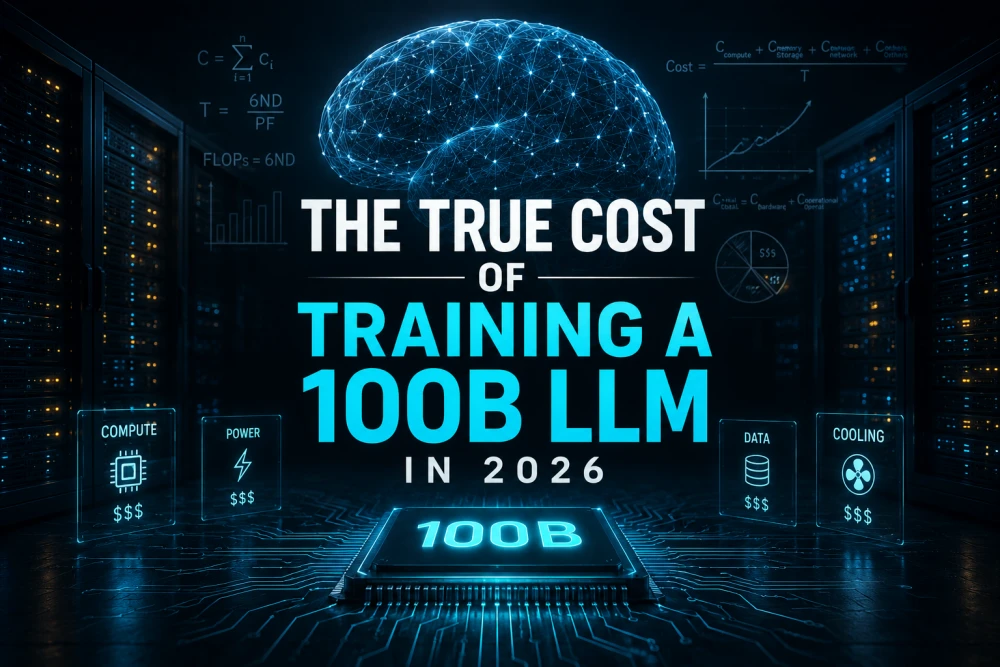
If you read the mainstream tech press, the narrative around training Large Language Models (LLMs) is binary: either it costs $100 million and is reserved strictly for OpenAI and Google, or it’s entirely commoditized and anyone can do it on their MacBook.
The reality, for AI startups and enterprise labs in 2026, lies somewhere in the middle.
Building a truly competitive, frontier-class model—specifically in the 100-billion parameter range (akin to Llama-3 70B or highly capable specialized models)—is no longer a theoretical research project. It is an engineering and financial calculus.
If you are a CTO or founder planning a training run of this magnitude, you cannot afford to guess your infrastructure costs. A 20% miscalculation in your compute budget can be the difference between successfully launching a state-of-the-art model and going bankrupt in the middle of a training loop.
The AI Compute Threshold Report
We analyzed pricing from 150+ GPU cloud providers to find the exact threshold where an AI startup's OpenAI API bill eclipses the cost of a dedicated H100 cluster.
Read the Full ReportIn this guide, we are going to break down the exact mathematics of training a 100B parameter LLM from scratch. We will calculate the FLOPs required, the GPU hours needed on modern hardware, and the massive financial discrepancies between different cloud providers.
The Mathematics of LLM Training
Before we look at dollar amounts, we must calculate the raw compute requirement. The standard heuristic for estimating the compute required to train a dense transformer model relies on the Chinchilla scaling laws, proposed by DeepMind.
1. Calculating Required FLOPs
The formula is generally accepted as:
Compute (FLOPs) ≈ 6 × Parameters × Tokens
- Parameters: 100 Billion (100,000,000,000)
Tokens: To train a 100B model to modern standards, you need massive amounts of data. Let’s assume a training dataset of 3 Trillion tokens (a standard benchmark in 2026 for high-quality models) 6 × 100,000,000,000 × 3,000,000,000,000 = 1.8 × 10^24 FLOPs (1.8 YottaFLOPs).This is a staggering amount of mathematical operations. To execute this, you need a massive cluster of enterprise-grade GPUs.
2. Calculating GPU Hours (NVIDIA H100)
The NVIDIA H100 (80GB SXM5) is the industry standard for large-scale training. On paper, an H100 can perform roughly 989 TeraFLOPs per second (FP16/BF16 without sparsity).
However, in reality, you never achieve 100% of theoretical peak performance. Due to networking bottlenecks, memory transfer overhead, and synchronization across thousands of GPUs, a well-optimized training run typically achieves a Model FLOPs Utilization (MFU) of around 45%.
- Effective FLOPs per H100: ~445 TFLOPs/second.
- Which equals: 1.6 × 10^18 FLOPs per hour, per GPU.
To calculate total GPU hours:
(1.8 × 10^24 Total FLOPs) / (1.6 × 10^18 FLOPs per hour) = 1,125,000 GPU Hours.
3. Time to Train
If you want to finish training this model in roughly 45 days, you need a massive cluster.
1,125,000 hours / (45 days × 24 hours) = 1,041 GPUs.
You will need a dedicated cluster of approximately 1,024 NVIDIA H100s (usually orchestrated in interconnected 8-GPU nodes) running non-stop for a month and a half.
The Financial Breakdown: Where You Train Matters
Now that we have the compute requirement—1,125,000 H100 hours—we can calculate the financial cost. This is where the choice of cloud provider becomes the most critical business decision your company will make.
The price disparity for an H100 across different providers is massive.
Scenario A: The Hyperscaler Premium (AWS / GCP / Azure)
If you default to the major hyperscalers, you will pay a premium for their vast ecosystem and brand name.
* Average Hyperscaler On-Demand Rate: ~$4.50 to $5.00 per H100 per hour.
* (Assuming you negotiate a 1-year reserved instance discount down to $3.50/hr).
* Total Cost (at $3.50/hr): 1,125,000 × $3.50 = $3,937,500.
Scenario B: The Specialized GPU Cloud (CoreWeave, Lambda, RunPod)
Specialized clouds that focus strictly on AI compute generally offer significantly better rates for raw metal.
* Average Tier-2 Rate: ~$2.20 to $2.50 per H100 per hour.
* Total Cost (at $2.40/hr): 1,125,000 × $2.40 = $2,700,000.
Scenario C: The Optimized Spot / Sovereign Cloud Route
If you utilize our ComputeStacker comparison engine to find heavily subsidized sovereign clouds, or string together massive spot instances from highly competitive international providers, you can often push costs below the $1.80 mark.
* Aggressive Market Rate: ~$1.70 per H100 per hour.
* Total Cost (at $1.70/hr): 1,125,000 × $1.70 = $1,912,500.
The Conclusion: By simply optimizing your infrastructure procurement, you can reduce the cost of training a 100B parameter model from nearly $4 million down to under $2 million.
The Hidden Costs of Training
The $2M to $4M calculated above is just the raw compute for the primary training loop. Any experienced AI researcher will tell you that the final cloud bill is always higher. You must account for the “Hidden OpEx”:
- Storage and Checkpointing: Storing petabytes of training data and constantly saving massive model checkpoints requires high-performance NVMe storage. This can easily add 10% to your total bill.
- Experimentation and Failures: You will not get the hyperparameters right on the first try. You will encounter loss spikes, hardware failures, and networking timeouts. A standard rule of thumb is to add a 25% to 30% buffer to your compute budget for abandoned runs, debugging, and data processing.
- Post-Training (Fine-Tuning & Alignment): Once the base model is trained, it is essentially useless until it undergoes Supervised Fine-Tuning (SFT) and Reinforcement Learning from Human Feedback (RLHF). While less compute-intensive than pre-training, it still requires significant GPU time.
Taking these into account, a safe budget for a 100B parameter model trained on 3T tokens in 2026 is between $3 Million and $5 Million, depending entirely on your infrastructure strategy.
How to Optimize Your Training Budget
If you are preparing to deploy millions of dollars on compute, you cannot rely on manual vendor negotiations alone. The market is too volatile, and pricing changes weekly.
This is the exact use case for ComputeStacker.
Our platform continuously tracks the live pricing of 156+ GPU cloud providers globally. If you need a cluster of 1,024 H100s, you do not need to settle for the standard AWS rate. You can use our Get Quotes tool to broadcast your hardware requirements to the top specialized providers in the world.
By forcing providers to compete for your multi-million dollar contract on a transparent marketplace, you ensure that you are paying the absolute lowest market rate for your compute, extending your runway and allowing you to train larger, more capable models.
Frequently Asked Questions (FAQ)
How much does it cost to train an AI model?
It scales entirely with parameter count and token volume. Fine-tuning a small 8B model might cost $50 to $500. Training a frontier-class 100B parameter model from scratch on trillions of tokens will cost between $2 Million and $5 Million in pure compute.
Why is an NVIDIA H100 required for training?
While you can train on older architectures (like the A100), the H100 features a Transformer Engine and FP8 precision support that drastically accelerates the matrix multiplications required for LLM training. The networking capabilities (NVLink) are also vastly superior, minimizing the bottleneck when synchronizing gradients across a 1,000-GPU cluster.
Can I use serverless GPUs to train a model?
No. Serverless GPUs are designed for inference (running a model to generate text or images). Training a massive LLM requires a dedicated, interconnected cluster of bare-metal GPUs communicating at massive bandwidths for weeks at a time.
How do I calculate my exact GPU needs?
Use the formula: (6 * Parameters * Tokens) / (MFU * Theoretical GPU FLOPs per hour). This will give you the total GPU hours required, which you can then multiply by the hourly rates found on the ComputeStacker Provider Directory.
Get personalised, no-commitment quotes from top AI infrastructure providers in under 2 minutes.