For the last decade, the standard playbook for launching a tech startup was practically written in stone: secure funding, claim your $100,000 in free startup credits from Amazon Web Services (AWS), Google Cloud Platform (GCP), or Microsoft Azure, and build your platform.
The hyperscalers provided an incredibly polished ecosystem. Everything from databases to load balancers was integrated seamlessly. You paid a slight premium for this convenience, but it was generally accepted as the cost of doing business.
Then, the Generative AI boom hit.
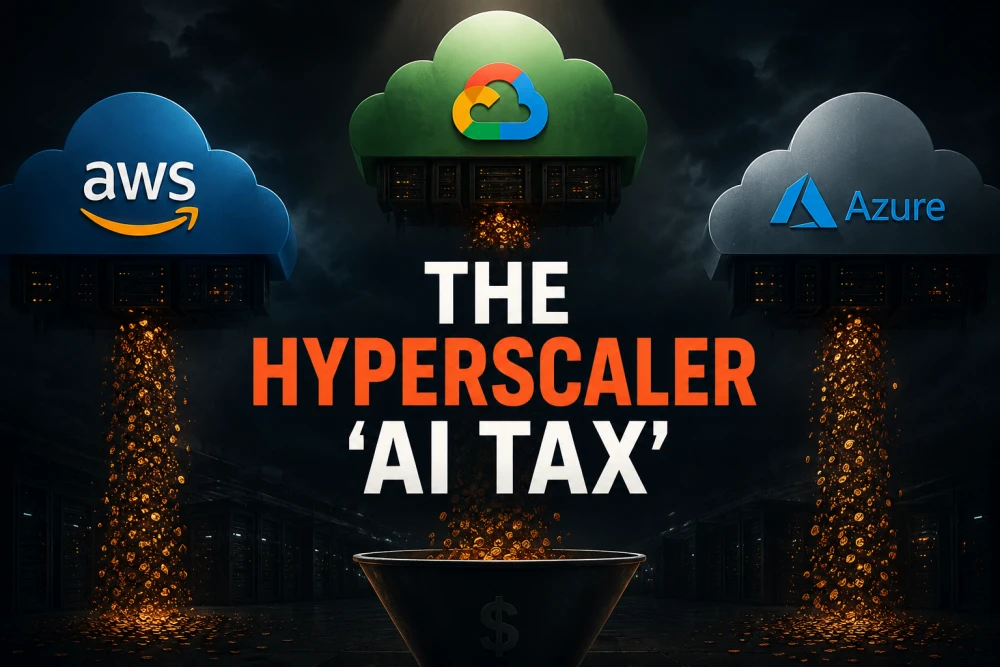
Suddenly, the primary line item on a startup’s infrastructure bill wasn’t standard EC2 web servers or S3 storage, it was massive clusters of NVIDIA A100, H100, and B200 GPUs. And as compute-heavy workloads became the norm, the “slight premium” charged by hyperscalers morphed into something much more damaging: The Hyperscaler AI Tax.
The AI Compute Threshold Report
We analyzed pricing from 150+ GPU cloud providers to find the exact threshold where an AI startup's OpenAI API bill eclipses the cost of a dedicated H100 cluster.
Read the Full ReportIn 2026, relying purely on the “Big Three” for heavy AI compute is no longer a strategic default; it is a massive financial liability. In this article, we will break down the exact mathematical markup you are paying when you rent GPUs from hyperscalers compared to specialized AI clouds, and how you can architect an infrastructure strategy to escape the tax.
The Raw Data: Hyperscalers vs. Specialized Clouds
To understand the magnitude of the AI Tax, we need to look at the raw hourly cost of renting the exact same piece of hardware across different platforms.
Let’s use the industry workhorse, the NVIDIA H100 (80GB), as our benchmark.
(Note: Pricing fluctuates, but these figures represent standard on-demand/short-term reserve pricing structures tracked via ComputeStacker’s live pricing engine).
The Hyperscaler Tier (The AI Tax):
* AWS (P5 Instances): ~$98 per hour for an 8x H100 node. This breaks down to $12.25 per GPU/hour.
* GCP (A3 Mega): ~$80 per hour for an 8x H100 node. This breaks down to $10.00 per GPU/hour.
* Azure (ND H100 v5): ~$80 to $90 per hour for an 8x node. Breaks down to $10.00 to $11.25 per GPU/hour.
The Specialized Cloud Tier (The Baseline):
Specialized providers (like CoreWeave, Lambda Labs, RunPod, and FluidStack) focus almost exclusively on bare metal GPU provisioning. Without the overhead of a million other services, their pricing reflects a much tighter margin on the hardware itself.
* Tier-1 Specialized (e.g., CoreWeave): ~$4.00 to $4.50 per H100/hour.
* Tier-2 Specialized / Marketplaces: ~$2.50 to $3.50 per H100/hour.
The Mathematics of the Markup
If we take a conservative average, specialized clouds charge around $3.50 per hour for an H100. Hyperscalers charge an average of $10.50 per hour.
That is a 300% markup for the exact same silicon.
If you are a startup running a small cluster of just 32 H100s for continuous inference or iterative training:
* Specialized Cloud Cost: 32 GPUs × $3.50/hr × 730 hours/month = $81,760 per month.
* Hyperscaler Cost: 32 GPUs × $10.50/hr × 730 hours/month = $245,280 per month.
You are paying an extra $163,520 every single month—nearly $2 million a year—simply for the privilege of keeping your GPUs under the same billing dashboard as your AWS RDS database.
Why Do Hyperscalers Charge So Much?
The hyperscalers aren’t necessarily price-gouging; their business models are fundamentally different from specialized AI clouds.
- The Ecosystem Premium: When you use AWS, you aren’t just renting a server. You are gaining access to IAM, VPC peering, managed Kubernetes (EKS), highly available block storage, and a thousand other integrated enterprise services. The GPU price subsidizes this massive orchestration layer.
- Network Architecture: Hyperscalers build their data centers for vast, highly available, multi-tenant web traffic. Specialized AI clouds often build their data centers specifically for massive, east-west “InfiniBand” traffic required for distributed GPU training. Specialized hardware requires specialized data centers, and retrofitting general-purpose hyperscaler data centers is incredibly expensive.
- The Credit Trap: Hyperscalers know they can charge higher rates because many startups are spending “free money.” If AWS gives you $200k in startup credits, you don’t care that the GPUs are 3x the market rate—until the credits run out. At that point, your architecture is deeply locked into their proprietary ecosystem, making migration painful.
How to Escape the AI Tax: The Multi-Cloud Architecture
You do not have to abandon AWS, GCP, or Azure entirely. They are still the best platforms in the world for hosting standard web applications, managing massive databases, and orchestrating complex microservices.
The most successful AI companies in 2026 employ a Compute-Specific Multi-Cloud Strategy.
1. Decouple Your Compute from Your Application
Host your frontend, your user databases, and your standard API gateways on your hyperscaler of choice. But for the heavy lifting—the actual model training and the heavy inference endpoints—deploy those workloads onto specialized bare-metal GPU providers.
2. Bridge the Gap securely
You can connect your hyperscaler environment to your specialized GPU cloud via secure VPN tunnels or dedicated interconnects. Your AWS web app receives a user request, fires a payload securely to your Lambda/CoreWeave GPU instance for processing, and receives the inference output back in milliseconds.
3. Use ComputeStacker to Find the Baseline
The specialized cloud market is highly fragmented. There are over 150 reputable GPU providers globally, and their pricing and availability fluctuate daily based on supply chains and hardware releases.
To successfully execute a multi-cloud strategy, you need a central source of truth for the GPU market.
ComputeStacker tracks live pricing, hardware availability, and compliance metrics across the entire global landscape of AI infrastructure. By using our comparison engine, you can instantly benchmark the hyperscaler quotes you receive against the true, raw market rate of specialized providers.
Furthermore, you can use our platform to get quotes from multiple specialized clouds simultaneously, ensuring you secure the lowest possible compute cost for your heavy workloads.
Conclusion
The era of defaulting 100% of your infrastructure to a single hyperscaler is over. In the age of Generative AI, compute is the primary driver of your COGS (Cost of Goods Sold).
Paying a 300% markup on standard web servers might cost a startup a few hundred dollars a month. Paying a 300% markup on H100 clusters will bleed millions of dollars from your runway. By treating GPU compute as a highly competitive commodity and leveraging specialized providers for heavy AI workloads, you can permanently eliminate the Hyperscaler AI Tax and redirect that capital toward building better models.
Frequently Asked Questions (FAQ)
Why are AWS and GCP GPUs so much more expensive?
You are paying for the vast ecosystem of integrated enterprise services, proprietary networking architectures, and the brand reliability of a massive hyperscaler. Specialized clouds strip away the unnecessary web-hosting tools and offer raw, bare-metal compute at a much lower margin.
What is a specialized AI cloud?
Specialized AI clouds (like CoreWeave, Lambda, RunPod, FluidStack) are infrastructure providers that focus almost exclusively on provisioning high-performance GPUs and the specific InfiniBand networking required for AI training and inference.
Is it hard to connect AWS to a different GPU provider?
No. It is a standard DevOps practice. You can set up secure VPC peering, VPN tunnels, or simply expose your specialized GPU endpoints securely via API. The slight increase in networking latency (often just a few milliseconds) is negligible for most AI workloads compared to the massive cost savings.
What happens when my AWS startup credits run out?
This is known as the “Credit Cliff.” If your AI application is highly dependent on expensive hyperscaler GPUs, your monthly burn rate will instantly triple or quadruple the day your credits expire. It is highly recommended to migrate your heavy compute workloads to specialized providers before the credits run out, reserving the credits for standard web infrastructure.
How do I compare AWS prices to specialized providers?
You can view the live, hourly rates of AWS, GCP, Azure, and over 150+ specialized providers side-by-side using the ComputeStacker Marketplace.
Get personalised, no-commitment quotes from top AI infrastructure providers in under 2 minutes.