The Brutal Reality of AI Infrastructure
In the rapidly evolving landscape of artificial intelligence, infrastructure is no longer just an IT operational detail—it is the absolute core determinant of a company’s unit economics, operational viability, and competitive moat. For CTOs, founders, and machine learning engineers scaling beyond the prototyping phase, the realization often hits like a freight train: managed APIs and serverless endpoints are financially unsustainable at scale.
When you are generating millions of tokens per day, training foundational models, or running constant batch inference jobs, the “success penalty” of per-token billing becomes a runway killer. This is the exact moment when the conversation pivots aggressively toward bare metal GPU renting.
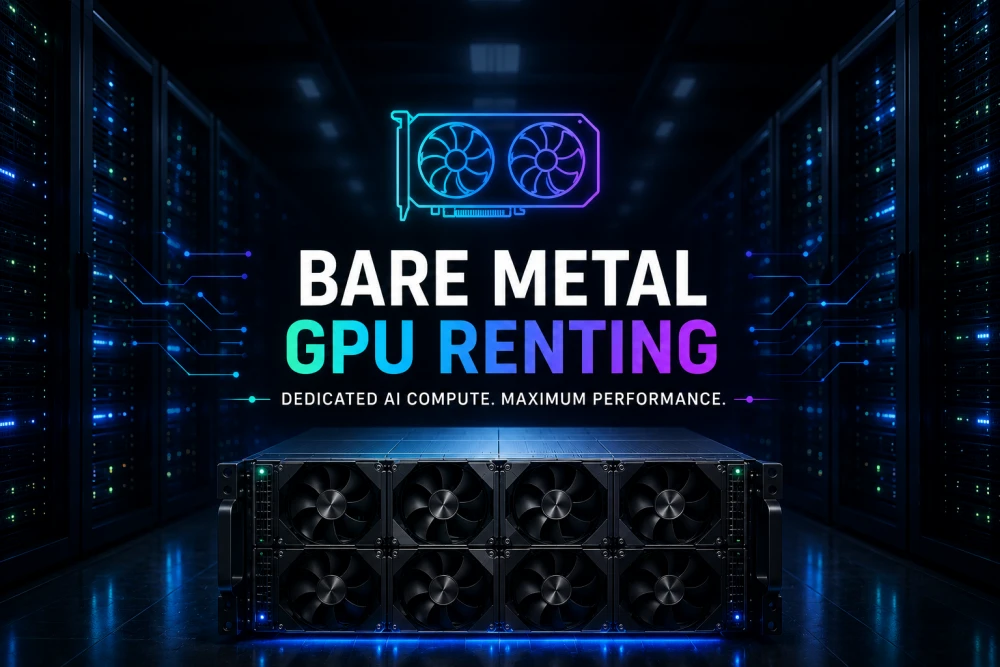
Bare metal GPU rental involves leasing a dedicated physical server equipped with high-performance accelerators—such as the NVIDIA H100, A100, or RTX 4090—directly from a data center provider. Unlike virtualized cloud environments (VMs) where hypervisors slice up resources, bare metal gives you unmitigated, single-tenant access to the underlying hardware. No noisy neighbors. No virtualization overhead. Complete root access.
When to Choose Bare Metal Over Managed APIs
The decision to migrate from a managed API (like OpenAI or Anthropic) to a dedicated bare metal cluster is almost always driven by math, not ideology. You should choose bare metal when:
The AI Compute Threshold Report
We analyzed pricing from 150+ GPU cloud providers to find the exact threshold where an AI startup's OpenAI API bill eclipses the cost of a dedicated H100 cluster.
Read the Full Report- Sustained High Utilization: If your GPU utilization rate exceeds 40-50% around the clock, paying for dedicated hardware is mathematically cheaper than paying per-second or per-token API rates.
- Data Privacy and Sovereignty: Enterprise clients in healthcare (HIPAA), finance (SOC2), or defense cannot send sensitive customer data to third-party black-box APIs. Bare metal ensures the data never leaves a physical machine you control.
- Custom Model Architectures: If you are running highly customized models, fine-tuned LLaMA-3 deployments, or proprietary architectures that require specific CUDA versions, bare metal provides the ultimate sandbox.
- Training and Fine-Tuning: While inference can sometimes be pushed to serverless, training requires massive, uninterrupted, parallelized compute power over days or weeks. This necessitates NVLink-connected bare metal clusters.
The Core Benefits: Control and Cost Efficiency
The primary advantage of bare metal GPU infrastructure is the dramatic reduction in the “compute poverty line.” When you bypass the profit margins of managed API providers and hyperscalers, the cost per FLOP plummets. For instance, renting an 8x NVIDIA H100 SXM5 server on a 1-year contract from an independent GPU cloud provider can yield cost savings of 60% to 75% compared to on-demand rates at AWS or Google Cloud.
Furthermore, the performance gains are non-trivial. Virtualization introduces latency—often called the “hypervisor tax.” In high-performance computing (HPC) and deep learning, micro-seconds matter. Bare metal ensures that your PyTorch scripts talk directly to the GPU via PCIe lanes without software middlemen, maximizing memory bandwidth and compute efficiency.
The Demerits: The MLOps Burden
It is critical to acknowledge that bare metal is not a silver bullet. The trade-off for ultimate control and low cost is the MLOps (Machine Learning Operations) burden. When you rent a bare metal server, you are handed an IP address and root credentials. That is it.
You are solely responsible for:
- Installing proprietary NVIDIA drivers, CUDA toolkits, and cuDNN libraries.
- Configuring Docker container runtimes (like nvidia-docker).
- Setting up load balancing, API gateways, and orchestration (e.g., Kubernetes).
- Handling node failures, thermal throttling, and hardware RMA processes.
If your team lacks a dedicated DevOps or MLOps engineer, the time spent configuring bare metal can quickly erase the financial savings. This is why bare metal is typically reserved for scale-ups and enterprises with internal engineering talent.
Feature Breakdown: What to Look For in a Provider
Not all bare metal providers are created equal. When evaluating the market via platforms like ComputeStacker, you must look beyond the hourly rate. Critical features include:
1. Interconnects (NVLink vs PCIe): For multi-GPU training jobs, the GPUs must communicate with each other faster than they communicate with the CPU. An 8x H100 server is practically useless for training large language models if it lacks NVLink (which provides up to 900 GB/s bidirectional bandwidth). PCIe-only servers are fine for isolated inference tasks but will bottleneck training.
2. Storage and IOPS: AI models are massive. An 8x GPU server needs local NVMe SSDs capable of saturating the PCIe bus to load model weights quickly. Network-attached storage (NAS) can throttle performance during checkpoints.
3. Network Bandwidth: If you are building a cluster across multiple nodes, you need InfiniBand or high-speed RoCE (RDMA over Converged Ethernet) at 400Gbps to 800Gbps per node.
Pricing Dynamics and The Spot Market
Bare metal pricing is heavily influenced by commitment length. On-demand bare metal is rare and expensive, often costing $20-$30+ per hour for an 8x A100 node. However, providers offer massive discounts for reserved instances (1-year to 3-year contracts).
If you are running interruptible workloads (like hyperparameter tuning or offline batch processing), you can leverage the spot market. Spot bare metal instances allow you to bid on unused data center capacity at discounts up to 80%, with the caveat that your server can be reclaimed with just a few minutes of warning.
Conclusion: The Foundation of AI Independence
Choosing bare metal GPU renting is a declaration of independence from the hyperscaler ecosystem. It is the infrastructure choice of established AI companies that view compute as their primary COGS (Cost of Goods Sold). By internalizing the complexity of deployment, companies unlock unparalleled margins, unthrottled performance, and absolute data sovereignty.
Get personalised, no-commitment quotes from top AI infrastructure providers in under 2 minutes.