The GPU Shortage Meets the Decentralized Solution
For the past few years, the artificial intelligence industry has been locked in a fierce battle for compute. The demand for NVIDIA H100s and A100s vastly outstrips supply, leading to long waitlists, monopolistic pricing by hyperscalers, and a severe bottleneck for AI startups.
Simultaneously, a massive supply of underutilized compute power exists globally. Data centers have idle servers during off-peak hours. Crypto miners sit on warehouses full of GPUs following Ethereum’s transition to Proof-of-Stake. Gaming cafes and independent operators have high-end consumer hardware collecting dust.
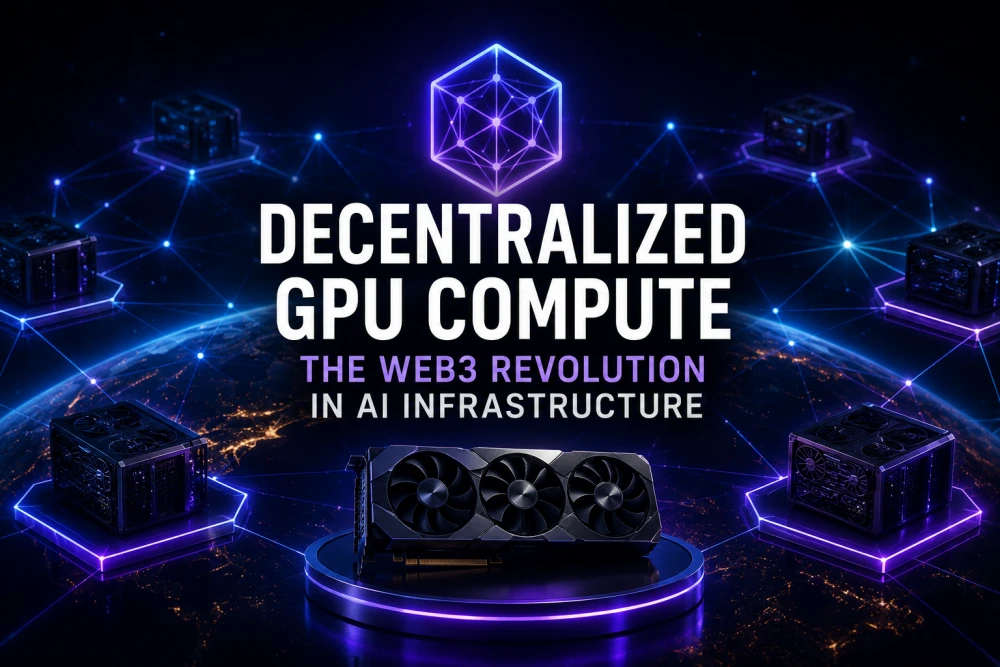
Decentralized GPU Compute is the Web3 technology bridging this gap. It creates permissionless, peer-to-peer marketplaces where anyone with idle compute can rent it out, and anyone needing compute can lease it, bypassing traditional cloud monopolies entirely.
What is Decentralized Compute?
Unlike AWS or Google Cloud, a decentralized compute network does not own any data centers. It is purely a software protocol—a marketplace layer. Providers include platforms like Render Network (specializing in 3D rendering but expanding to AI), Akash Network (a generalized decentralized cloud), and io.net (specifically aggregating GPUs for machine learning).
The AI Compute Threshold Report
We analyzed pricing from 150+ GPU cloud providers to find the exact threshold where an AI startup's OpenAI API bill eclipses the cost of a dedicated H100 cluster.
Read the Full ReportWhen you deploy a workload on these networks, you are renting hardware from independent node operators around the world. The network’s blockchain handles the matchmaking, verifies that the compute was actually performed (Proof of Compute), and executes the payment via smart contracts (often using a native crypto token).
When to Choose Decentralized Providers
Decentralized compute is still the “Wild West” of AI infrastructure, but it offers massive advantages for specific use cases:
- Extreme Cost Optimization: Because node operators have sunk costs in hardware and do not have the overhead of corporate hyperscalers, prices are driven to the absolute floor. It is common to find GPUs for 60% to 80% less than AWS rates.
- Permissionless Access: There are no sales calls, no KYC (Know Your Customer) bottlenecks, and no “insufficient quota” errors. If you have the crypto tokens to pay, you can instantly lease 100 GPUs anonymously.
- Batch Processing and Interruptible Workloads: If you are running massive offline batch inference jobs, hyperparameter sweeps, or Monte Carlo simulations where a node failing simply means the job restarts elsewhere, decentralized compute is perfect.
- Uncensored Workloads: Hyperscalers have strict Terms of Service regarding what models you can run. Decentralized networks are censorship-resistant.
The Core Benefits: Price Discovery and Global Reach
The primary benefit of decentralized compute is true free-market price discovery. Many of these protocols operate on a “Reverse Auction” or bid-based system. You specify your workload requirements and the maximum price you are willing to pay per hour. Node operators bid to execute your workload. When demand is low, you can secure enterprise-grade GPUs for pennies on the dollar.
Additionally, because the nodes are globally distributed, you have compute availability across every geographic region. If you need latency-sensitive inference near users in Southeast Asia or South America, you can often find local node operators on the network, bypassing the need for a major cloud provider to build a data center there.
The Demerits: Trust, Reliability, and Crypto Friction
The decentralized model requires significant trade-offs, making it unsuitable for many traditional enterprises:
1. Reliability and Uptime: You are renting from independent operators. While the protocol incentivizes uptime via staking (operators lose money if they go offline), node failures are much more common than on AWS. You must architect your application to be entirely fault-tolerant.
2. Security and Data Privacy: When you send your proprietary model weights or sensitive customer data to a decentralized node, it is executing on a machine owned by a stranger. While some protocols are developing Confidential Computing (using Secure Enclaves to encrypt data even during processing), it is generally unsafe to process highly regulated data (PII, HIPAA) on decentralized networks.
3. Crypto Friction: To use these networks, your accounting department must acquire, hold, and transact in cryptocurrency (like AKT or RNDR). For many Web2 companies, this introduces unacceptable accounting and regulatory compliance friction.
Feature Breakdown: The Deployment Experience
Deploying on a decentralized network is conceptually similar to deploying on Kubernetes. You define your workload in a YAML-like configuration file, specifying the Docker image, required CPU/RAM/GPU, storage, and networking ports. The protocol then broadcasts this manifest to the network.
Once an operator bids on the manifest and you accept, a secure tunnel is established, and your Docker container is deployed onto their node. From your perspective, you interact with the container exactly as you would on a traditional cloud.
Pricing Dynamics: The Token Economy
Pricing is dynamic and volatile. Because leases are often denominated in a native cryptocurrency, the fiat cost (USD) of your compute can fluctuate based on the token’s market price. However, many newer protocols are implementing stablecoin payments (like USDC) to provide predictability for enterprise clients.
Payments are handled via continuous escrow. You deposit funds into a smart contract, and the network streams micro-payments to the provider on a per-minute or per-block basis. If you terminate the workload, the remaining funds are instantly returned.
Conclusion: The Frontier of Compute
Decentralized compute is the most disruptive force in the AI infrastructure market today. While it currently lacks the enterprise-grade guarantees required for mission-critical production systems, its unmatched cost efficiency makes it an incredible tool for research, training, and fault-tolerant inference. As the protocols mature and abstraction layers simplify the crypto integration, it will pose a serious threat to the hyperscaler monopoly.
Get personalised, no-commitment quotes from top AI infrastructure providers in under 2 minutes.