Recently, Anthropic inked a $35 billion, six-year contract with Lambda, which is a cloud services company backed by Nvidia. The most important part of this deal doesn’t come from the figure in the headline.
The reality is that Nvidia won’t only provide chips for this deal but also invest in Lambda. Also, Nvidia holds the lease for the data centre that will run these chips.
Thus, Nvidia is fulfilling all three roles here: supplier, investor, and landlord. This contract can be called Anthropic-Lambda on paper. But in reality, it’s an Anthropic-Nvidia deal.
Key takeaways
- Anthropic has entered into a 350MW, six-year, $35 billion contract with Lambda, which is backed by Nvidia, on its Beacon Point campus in Texas.
- Nvidia owns the data centre lease itself, which is an odd situation, causing speculation among analysts.
- This is one of at least four huge contracts that Anthropic has entered into in 2026, totalling more than $135 billion in committed compute capacity.
- However, this is not exclusive to Anthropic alone; OpenAI, Microsoft, and all the big hyperscalers have made similarly huge commitments.
- In fact, it also reduces the amount of GPU capacity available for renting to others.
- Anthropic’s own revenue growth, from about $1 billion to $65 billion annualised in 18 months, drives this spending.
Why Anthropic requires so much compute
None of this makes sense without the demand side. Anthropic’s annualized revenue grew from roughly $1 billion in December 2024 to about $65 billion by July 2026, according to independent tracking by research firm Sacra. Anthropic hasn’t published this figure itself.
The AI Compute Threshold Report
We analyzed pricing from 150+ GPU cloud providers to find the exact threshold where an AI startup's OpenAI API bill eclipses the cost of a dedicated H100 cluster.
Read the Full ReportClaude Code, a coding-focused software offering from Anthropic, was also a significant contributor to that result. The product reached $1 billion in annualised revenue in November 2025 and more than doubled shortly after that date. Enterprise users represent most of that user base.
GPUs perform all of those queries somewhere. With growth in revenue at such a pace, a similar level of demand for inference accompanies it.
Demand is further increased by training the next generation of products on top of that. Anthropic is not acquiring capacity for speculative purposes; it acquires capacity to match demand that is already occurring.
You should keep all the above in mind when considering the following deal. It is not a purchase related to future growth expectations. It is an attempt to catch up with demand growth that has already outpaced current supply.
How the Anthropic Lambda agreement is structured
The facts are obvious. Anthropic will have six years’ access to about 350 megawatts at the Beacon Point campus of Hut 8 in Texas.
To put that in perspective, 350MW roughly works out to the continuous draw of a mid-sized US city, based on typical household power use. That’s the scale of a single compute deal now.
Lambda operates the site. Nvidia provides the chips.
Where it gets weird is the ownership. Nvidia owns the actual lease for the data centre. This comes from reports in the Wall Street Journal, independently confirmed by Reuters and AFP.
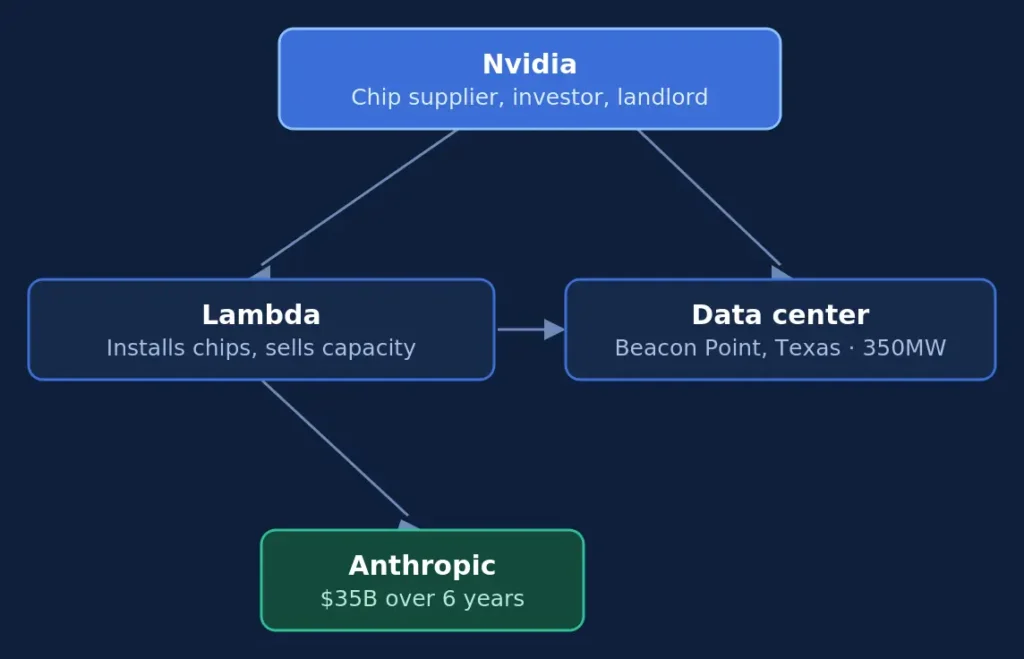
Lambda never has to purchase or lease physical real estate. They plug Nvidia chips into buildings that Nvidia already occupies and rent the compute capacity out to Anthropic.
How does this work? Nvidia has what neither Lambda nor Anthropic has: an investment-grade credit rating. Neither AI company could readily finance such a facility themselves.
It would appear that this agreement works differently for all parties involved. Lambda doesn’t need to take any real estate risks to get a huge contract. Nvidia guarantees its product demand. Anthropic gains capacity that it wouldn’t be able to finance on its own.
Also, this discussion should not overlook Hut 8. As the company behind this project, it appears to be not a small player here. SEC filings of Hut 8 indicate two 15-year leases worth 704 MW at Beacon Point, with base-term values of $19.6 billion. Hut 8 expects this fully launched campus to generate $1.3 billion in operating income annually.
This time frame is not going to be quick. Hut 8’s public disclosures indicate that the company expects to energise this campus initially in Q1 2027 and deliver the first data halls by Q3 2027. Anthropic will not even begin using this capacity soon.
This is exactly what draws criticism to the project. The Bank for International Settlements flagged circular financing in its 2026 annual report.
Think of it like an auto company making loans to customers buying its vehicles. Additionally, the company controls the entire dealership lot that houses its cars. Every single part looks perfectly fine on its own.
However, when together, they result in the company’s success hinging mostly on its own bullish forecast.
This is not purely hypothetical, because in case of any drop in demand for AI, Nvidia will be liable for the role of landlord, investor, and chip supplier altogether. There are no third parties who take responsibility for the risk.
Jordan Klein of Mizuho called the full scheme “concerning,” adding that Nvidia is making a bet on its own demand forecast. Neither Anthropic nor Lambda has confirmed the details of the agreement publicly so far.
Yet, not everybody sees it as a problem. For decades before the rise of AI, the infrastructure always needed a counterparty with great credit.
Examples include the cases of data centres, railroads, and telecom network construction. The more balanced opinion is quite different.
Nvidia is the only player whose balance sheet is large enough to move so quickly.
It’s not a one-time thing
Looking at the broader picture, the Lambda deal represents just the latest in a string of mammoth AI compute deals announced in recent months. Anthropic has previously entered into deals for $45 billion with Nscale for capacity in West Virginia.
That includes a $50 billion deal with Fluidstack and a $45 billion capacity agreement with SpaceX. Factoring in the Lambda deal, Anthropic has committed to $135 billion+ of computing power for 2026 alone. Estimates have put Anthropic’s total compute commitment above $180 billion.
SpaceX’s deal deserves further discussion. The company gives Anthropic full capacity at Colossus 1, the Memphis supercomputer, which was built by rival xAI. Colossus 1 has over 220,000 Nvidia GPUs at its disposal.
Before Anthropic took control, the facility ran at just 11% utilization. That means there’s plenty of hardware going to waste.
Anthropic is paying $1.25 billion a month for this service until May 2029. The Fluidstack deal covers new US facilities in Texas and New York built specifically for Anthropic’s needs.
Anthropic is not an exception here. Rather, it is part of a larger trend. OpenAI has already committed more than $400 billion of capacity to Stargate, Oracle, CoreWeave, and Microsoft.
Microsoft alone is guiding toward roughly $190 billion in 2026 capital spending. Across the five largest hyperscalers, combined 2026 AI infrastructure spending is tracking toward $660 to $690 billion.
These deals also tend to loop back on themselves. Microsoft’s stake in OpenAI sits at roughly 27%, and OpenAI has committed $250 billion back to Azure.
Amazon has already spent more than $83 billion on Anthropic and OpenAI combined. They have also entered into a commitment to purchase capacity from AWS in exchange. The same money goes around in circles within a few companies.
That doesn’t mean that this approach is unsustainable, but it means that risk is concentrated. Any breakage in such a chain would affect multiple companies at once, not just one company.
The arrangement of deals is important in such cases as well. AI labs do not rent GPU capacity gradually when they need it anymore; instead, they pre-purchase the capacity for years ahead in one deal.
What this actually means if you’re trying to rent GPU capacity yourself
Here’s the piece that gets omitted from most discussions of this deal. As Anthropic takes 350MW of capacity for six years in one go, that capacity no longer becomes available for other customers for those six years.
It is just basic supply and demand. Data centre capacity, electricity, and the latest generation GPUs all take years to produce. Once AI labs take that capacity a few years in advance, everyone else is fighting over the remainder.
That, multiplied by each mega-deal made this year, translates into a structural tightening for everyone who is not under these contracts. GPU capacity crunch coverage has also tracked rising rents this year already.
These mega-deals are a contributing factor to that. Look for continuing tightness in hyperscaler on-demand capacity, particularly for the latest generation GPUs.
However, the impact is not the same on each purchaser. Startups and small teams buying on-demand capacity will face this challenge more acutely since there is no negotiating power here, unlike where enterprises purchase committed-use capacity.
However, this is not all bad news for each purchaser. This is also why other customers seek alternative capacity layers.
Sovereign and neocloud providers now operate in markets such as Sydney’s GPU cloud market. They exist partly because mega-deals like this one keep pulling hyperscaler capacity out of general circulation.
If you are planning to deploy in the next year, you need to take this into account as well.
FAQs
Has Anthropic or Lambda finalized the deal yet?
No. At the time of writing, the arrangement depends on information in The Wall Street Journal, verified through sources at Reuters and AFP. Anthropic or Lambda has not made a statement about the arrangement or financial details.
Why is Nvidia the one leasing the data centre rather than Lambda or Anthropic?
Nvidia has an investment-grade credit rating, which Lambda and Anthropic do not have. Thus, Nvidia’s participation as the landlord makes a difference between a facility that can get financed and one that is not.
How much total computing capacity has Anthropic committed to in 2026 altogether?
Estimates differ. However, the arrangements for 2026 made by Anthropic with Nscale, Fluidstack, SpaceX, and Lambda sum to more than $135 billion. Some estimates go as high as $180 billion.
Does this kind of deal actually affect GPU pricing for smaller companies?
Yes, indirectly. The space tied up in a six-year agreement with one client is not available for renting to any other company. Thus, as companies make more big agreements, on-demand capacity availability decreases, causing higher rent costs.
What exactly is Lambda, and why is it central to so many of these deals?
Lambda is a cloud provider that focuses on Nvidia GPU infrastructure. They do not own data centres themselves but collaborate with data centre owners and their hardware backers such as Nvidia. In this way, they manage to secure massive agreements while avoiding risks related to real estate.
Why does Anthropic need $135 billion worth of compute if it isn’t profitable yet?
The growth rate of Anthropic’s income is quite fast; therefore, the current consumption of resources is larger than the existing infrastructure capacity. It is usual practice for companies developing this rapidly.
Deals like this are becoming the norm, not the exception
Last year, one compute deal worth $35 billion would have made this the most important infrastructure news of the quarter. This time, it’s just one out of four deals that Anthropic alone has done in the past few months. There’s no end in sight to this trend.
Two things to watch out for moving forward are: first, whether Anthropic, Lambda, or Nvidia makes any official confirmation, and second, how regulatory authorities respond to the circular financing issue highlighted by the BIS.
For anyone leasing GPU compute capacity beyond these big deals, here is an obvious lesson: The biggest AI labs are planning way ahead, and that means less available capacity for the rest of us. To find out which, look at ComputeStacker’s provider index.
Get personalised, no-commitment quotes from top AI infrastructure providers in under 2 minutes.