A neocloud rate card could appear to be 60% cheaper than AWS or Azure, without you having to pay anything yet. And then you get your first invoice from them, filled with egress costs, idle GPU costs, and a support cost nobody anticipated.
An apples-to-apples comparison of different GPU clouds based on their stated hourly rates would be similar to comparing automobiles on their sticker prices only. Without considering insurance, fuel, and maintenance.
The real question of choosing between neocloud and hyperscaler comes not from comparing rate cards and trying to choose a lower one. The real question lies in which total cost wins after tallying all the items.
This article provides a detailed breakdown of AWS, Azure, GCP, CoreWeave, and Lambda costs associated with their H100 GPUs. An analysis of what each cloud company tries to hide in its rate card follows.
The AI Compute Threshold Report
We analyzed pricing from 150+ GPU cloud providers to find the exact threshold where an AI startup's OpenAI API bill eclipses the cost of a dedicated H100 cluster.
Read the Full ReportKey Takeaways
- Neoclouds’ on-demand H100 pricing ranges between $3.99 and $6.16/GPU/hour, whereas hyperscalers range between $6.88 and $12.29/GPU/hour.
- Lambda is the cheapest at $3.99/GPU/hour compared to other pricing on its currently live pricing page; correcting for out-of-date pricing figures showing $2.99 elsewhere.
- Neoclouds do not charge any egress costs; AWS charges around $0.09/GB beyond a 100GB free tier.
- Based on an 8 GPU instance over 30 days, CoreWeave and Lambda together make up around half to a third of Azure’s cost, including egress costs.
- Even AWS’s reserved pricing helps close the gap: a three-year commitment brings down its on-demand price by 57%, almost to Lambda’s on-demand price.
- There is still a premium for compliance certifications, customer support, and existing enterprise deals that neo-clouds lack.
What is a Neocloud, really?
Neoclouds specialise in providing a single type of resource: GPU capacity for AI and machine learning workloads. Well-known representatives of the niche include CoreWeave, Lambda, Nebius, and Together AI. In most cases, these companies offer their services through self-service, Kubernetes-native platforms rather than through a comprehensive console and service catalogue of a hyperscaler.
In contrast to neoclouds, a hyperscaler such as AWS, Azure, or GCP offers not just hundreds of other services but sells them in a single package. A GPU instance is only one piece of the puzzle, surrounded by other elements such as storage services, networking capabilities, compliance tools, account management, etc.
This difference in architecture is also a cause of price variation: neoclouds typically purchase GPUs in bulk from NVIDIA and resell them, while hyperscalers have to offer the entire platform together.
Our hyperscaler comparison of AWS, GCP, and Azure will help you learn the pros and cons of each service. However, this article deals solely with the price comparison issue.
Neither approach is inherently better. Everything depends on your priorities, which can be the lowest possible compute cost, or enterprise-level integration, or anything in between.
GPU Cloud Pricing: Neoclouds vs Hyperscalers at a glance
Here’s what a single on-demand NVIDIA H100 costs across five major providers, as of late September 2026:
| Provider | Type | On-demand rate (per GPU-hour) |
| Lambda | Neocloud | ~$3.99 |
| CoreWeave | Neocloud | $4.25–$6.16 (varies by product tier — see below) |
| AWS | Hyperscaler | $6.88 |
| GCP | Hyperscaler | $11.06 |
| Azure | Hyperscaler | $12.29 |
The spread is real. At the extremes, Azure’s on-demand rate runs roughly three times Lambda’s.
But a sticker-price table only tells you what an hour of compute costs. It doesn’t say what a month of usage actually costs once egress, idle time, and support get added in. The next three sections work through each of those pieces.
H100 Pricing by Provider: What AWS, Azure, and GCP actually charge
The cost of the Hyperscaler H100 varies, and each provider structures it differently instead of depending on a single price.
AWS H100 Pricing
At AWS, the H100 is available under a P5 instance family. The price for a single GPU p5.4xlarge instance is $6.88 per hour in a US East region. Two tracking websites, such as devzero.io and Holori, verify this figure.
The P5 page at AWS verifies the specification of the instance, but since the prices there render dynamically, the exact figure is unquotable from there.
Prices are increasing in other regions. Some trackers present the same instance as being available for over $11 per hour outside the US. Reserved one-year and three-year terms reduce the on-demand price by about 20 to 57% depending on the term.
US East price is not everything, since regional prices increase from there, as shown by Holori’s regional pricing tracker.
Asia Pacific (Mumbai) costs $8.26 per hour. Asia Pacific (Tokyo) costs $8.60 per hour. South America (São Paulo) costs $11.56 per hour, the highest among the examined regions.
The reserved pricing plan saves even more money. If you make a one-year upfront commitment, you can bring down the price to $5.42 per hour, or 21%. If you opt for a three-year EC2 Instance Savings Plan, the price will drop to $2.97 per hour; that’s 57% off and very close to Lambda.
Finally, Spot pricing drops the price even further to $2.47 per hour in the least expensive availability zone. It is lower than any other neocloud rate mentioned in this article.
Azure H100 Pricing
The H100 VM of Azure, the ND96isr H100 v5, comes with eight GPUs for an hourly price of $98.32, or $12.29 GPU/hour, according to the Azure Retail Prices API provided by Microsoft. If you want to save some money using spot pricing, the total hourly price would be around 70-75 with the regular spot eviction policy applied.
GCP H100 Pricing
The machine type a3-highgpu-8g on Google Cloud Platform gives access to eight H100 GPUs for $88.49 per hour, which results in the price of $11.06 GPU/hour. This is how Google Cloud’s accelerated computing pricing page suggests you pay.
In case you choose spot pricing, you’ll get a discount ranging between 60% and 91% depending on the instance type.
All in all, the principle stays the same. On-demand is the maximum price you’d ever need to pay.
CoreWeave and Lambda: What two neocloud providers actually charge
CoreWeave H100 Pricing
Two different H100s appear on CoreWeave’s own pricing page, and it will be helpful to know which one pertains to a particular quote. The classic pricing page of CoreWeave includes a listing for an H100 PCIe GPU at $4.25 per hour. An HGX H100 GPU goes for $4.76 per hour from that page.
On the other hand, CoreWeave’s current pricing page includes an HGX H100 node priced at $49.24 per hour. This is the complete package with 8 GPUs that is actually being provisioned by training teams, at $6.16 per GPU hour.
This is just a matter of two different products listed on two different pages. Make sure you have identified the configuration before comparing CoreWeave to any other vendor.
Lambda H100 Pricing
The Lambda on-demand H100 SXM instances cost $3.99 per GPU-hour, charged in minutes, not in hours. Lambda’s live price page confirms this price, along with their no egress fee policy.
This price overrides the $2.99 per GPU-hour price found in several out-of-date price trackers, and even in some of Lambda’s outdated blog posts. An authoritative source may become outdated if not the latest page.
Both services are self-service. Neither needs a sales call for provisioning one GPU instance, which makes them unique among hyperscaler reserved capacity services.
What your hourly GPU rate doesn’t include
The hourly price is the headline, but not the full story.
Outgoing Data Transfer. AWS will charge you for data transferred out of its network beyond a monthly free threshold, at $0.09 per GB until the first 10 TB. This is according to Cloudflare’s calculation of AWS’s outgoing data transfer pricing rates, confirmed by 7 other independent trackers.
Lambda and CoreWeave both state on their pricing pages that there’s no fee for outgoing data transfers. If your team routinely exporting trained checkpoints or datasets, this discrepancy can add up quickly.
Idle Time and Minimum Commitments. A reserved but idle GPU will incur a charge – one of the biggest discrepancies between advertised price and true cost. We’ve detailed the whole story in our hidden costs of GPU cloud article.
Provisioning Delay. Even if availability doesn’t directly change profits, it can still affect spending. According to an article that cites CoreWeave’s Q1 2026 earnings call, the company’s CFO had this to say regarding their capacity and provisioning delays.
CoreWeave nearly sold out its 2026 capacity while it increased the price of all its GPU offerings. The team waiting for its quota or capacity suffers from delays, even if the price remains unchanged. Support & Compliance. The hyperscalers provide enterprise support plans, account management, and certification programs such as SOC 2 and HIPAA. Neocloud vendors are working on addressing this gap, but the level of availability is provider-specific.
Neocloud vs Hyperscaler TCO: A worked 8-GPU example
And this is how the numbers actually play out for an 8-GPU H100 training job over 30 days. The workload runs uninterrupted for 720 hours, transferring about 5 TB of checkpoints/data in and out over the period of a month.
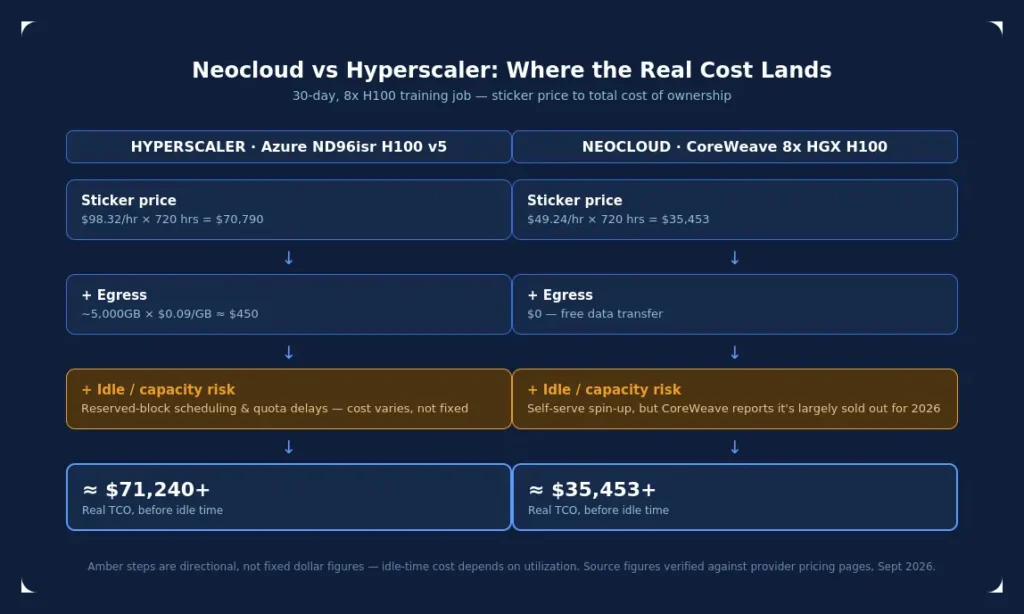
Azure (ND96isr H100 v5):
- Compute: $98.32/hr × 720 hours = $70,790
- Egress: ~5,000GB × $0.09/GB ≈ $450
- Total: ≈ $71,240
AWS (8x p5.4xlarge, US East):
- Compute: $6.88/hr × 8 GPUs × 720 hours = $39,629
- Egress: ~5,000GB × $0.09/GB ≈ $450
- Total: ≈ $40,079
CoreWeave (8x HGX H100 node):
- Compute: $49.24/hr × 720 hours = $35,453
- Egress: $0 (per CoreWeave’s published data-transfer policy)
- Total: ≈ $35,453
Lambda (8x H100 SXM, on-demand):
- Compute: $3.99/hr × 8 GPUs × 720 hours = $22,982
- Egress: $0 (per Lambda’s published data-transfer policy)
- Total: ≈ $22,982
Lambda pricing comes out to be about one-third of Azure, while CoreWeave comes close to half of it. AWS fits right in between the hyperscalers and neoclouds. The difference in pricing, before considering the egress costs, stands true in all cases.
But in this scenario, we’ve assumed no capacity issues or compliance requirements for the workloads, which would have taken them to a hyperscaler. The subsequent section deals with this problem.
When the hyperscaler premium is worth paying
The math in question always favours the neocloud unless run in isolation.
A compliant workload is required to be executed inside an established compliance perimeter. Moving data from a particular AWS or Azure contract results in triggering a re-evaluation of the compliance.
A group with an established enterprise agreement will acquire GPU power at reduced costs. These costs are lower because of the existing contractual obligation.
Requirements of a sovereign region may make the use of a neocloud operating outside of the region impossible.
All of this is never taken into account while evaluating costs on a per-GPU hour basis.
FAQs
Can I negotiate a neocloud provider’s listed price?
Often, most definitely when buying in bulk, published prices are mostly the starting price and not the final price, which depends on how committed the user is to buying that number. Most neoclouds don’t publicise any discounts.
Is a neocloud or a hyperscaler better for an AI startup?
Without compliance, dedicated support, or an established infrastructure in place like the one in AWS and Azure, a neocloud is cheaper in a single training run.
What happens if a neocloud runs out of capacity?
Neoclouds sells capacity on a first-come, first-served basis without guaranteed renewal. If the supplier of neocloud services, such as CoreWeave, runs out of capacity, the instance will continue to run.
However, scaling up and renewal at the same rate is not necessarily guaranteed. The hyperscaler offers capacity reservations and committed use agreements, which guarantee the availability of capacity.
How often do H100 cloud prices change?
This happens often enough for the snapshot to become stale quickly. This article’s rates are based on the providers’ pages of late September 2026.
Conclusion
The sticker price disparity between neoclouds and hyperscalers is real, and it persists even given egress fees and idle costs. Lambda and CoreWeave initially cost less than Azure by a wide margin in the example above. It remained so, even after factoring in the additional charges hyperscalers add, and neoclouds don’t.
It does not mean, however, that the choice becomes clear-cut. A team that has committed itself to AWS or Azure will simply pay more, regardless of the calculations, for whatever reason. This also applies to a team that needs SOC 2 certification or dedicated support immediately, not in the future.
The best approach is always to perform the necessary calculations on a case-by-case basis with a particular workload in mind. Use current pricing information provided directly by each cloud provider, not last quarter’s blog posts. The numbers in this article will certainly change next year; GPUs are volatile.
Get personalised, no-commitment quotes from top AI infrastructure providers in under 2 minutes.