AI is growing very quickly from a financial perspective, but so are its costs.
For every response, suggestion and agent run within Chat, Code or Agent systems, GPU resources are being consumed and at significant costs. This has rarely decreased as quickly as the hype around AI, giving rise to three key questions.
Do hardware, cloud and model providers make money? Can AI startups achieve good margins (like software)? And does AI pay in the businesses which utilise AI?
This guide analyses these 3 questions using the most up-to-date 2026 filings/surveys. Points of contradiction in the data will be highlighted.
The AI Compute Threshold Report
We analyzed pricing from 150+ GPU cloud providers to find the exact threshold where an AI startup's OpenAI API bill eclipses the cost of a dedicated H100 cluster.
Read the Full ReportIs AI profitable? The short answer
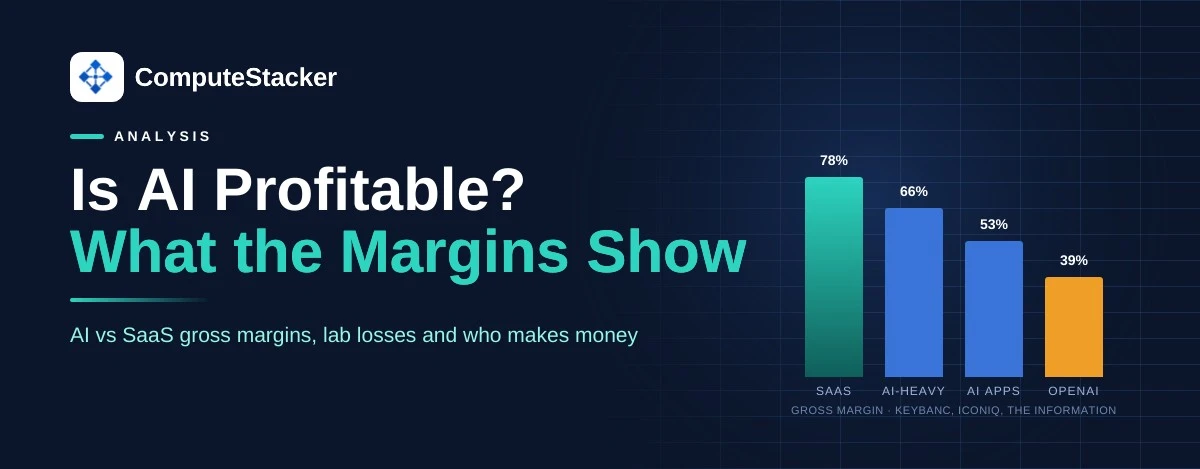
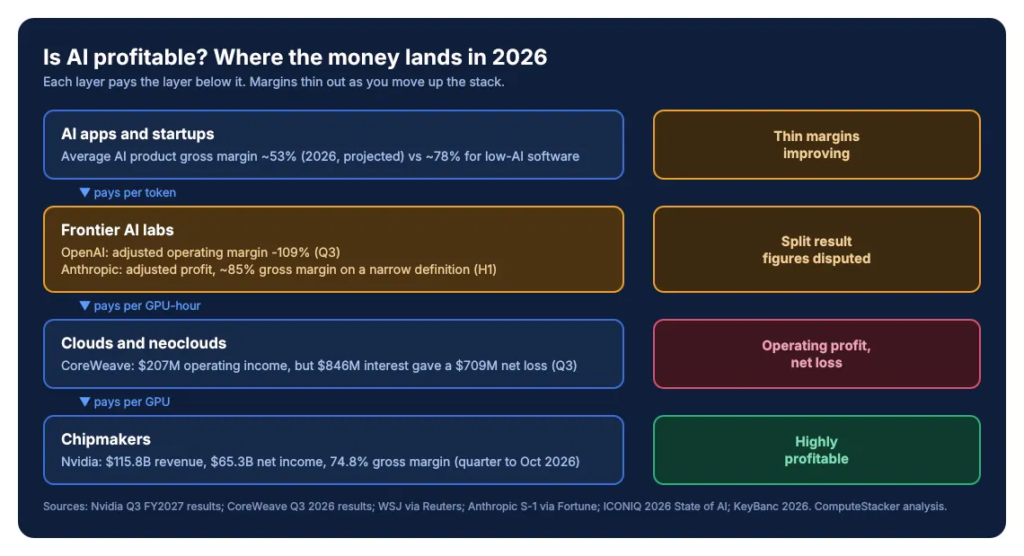
It varies. While chip manufacturers like Nvidia are seeing large margins, model or AI startups tend to get into the red. Gross margins on AI products are around 53% on average (ICONIQ, 2026) while software with minimal AI sees gross margins of approx 78%.
Therefore whilst profit is generated by those providing the computational power in the AI stack, everyone above is effectively paying a cost in their margins.
Who is actually making money from AI right now
Chipmakers and hardware suppliers
Nvidia is the plainest answer. In the quarter to 25 October 2026, it reported revenue of $115.8 billion and GAAP net income of $65.3 billion. Its GAAP gross margin was 74.8%, close to what elite software firms earn.
Sales within data centres accounted for $107.6bn. Nearly all of this was driven by customers adding AI capability. Memory vendors and interconnect vendors will also benefit as each GPU requires high bandwidth memories and high speed interconnects.
Cloud providers and neoclouds selling GPU time
In this segment hardware is rented and the story is not quite as positive. CoreWeave, the largest neocloud listed, saw revenue increase 168% in Q3 to reach $3.66 billion. However, it had operating income of just $207 million.
This was offset by interest expenses of $846 million which resulted in a net loss of $709 million. As neoclouds take on a lot of debt to purchase GPUs, interest costs can often lead to an overall loss. We break down how neoclouds compare in terms of costs to hyperscalers to see why they can still offer competitive pricing.
Hyperscalers like AWS, Azure and Google Cloud have far broader businesses to distribute these costs across, and have increased prices given sustained high demand (see increasing GPU rental prices).
Why the money flows to compute first
Each level pays the one below. The AI application pays the lab, which pays the cloud, which pays Nvidia. Each payment includes a cut for the previous tier.
There is also scarcity in this value chain. As GPUs are in short supply, sellers can set prices. As such, the safest profits in AI are made by those at the lowest level in this value chain.
How profitable are the big AI labs?
The two largest independent labs now show very different results. Both still spend enormous sums on compute, but their reported margins have split apart.
OpenAI’s revenue vs its compute bill
While OpenAI’s revenues have increased by around 50% to $10 billion in Q3 2026 (as seen in investor documents by The Wall Street Journal), as reported by The Next Web, its adjusted operating losses have grown to $10.9 billion from $10.1 billion.
As such, OpenAI had a negative net income. The gross margin was also hit hard. In 2025, the adjusted gross margin was 33%. However, this improved in Q1 2026 to ~39%.
Inference is the main drag. The Information reported that OpenAI’s inference costs roughly quadrupled in 2025, outpacing its revenue gains.
How Anthropic compares
Anthropic’s initial public offering documents show that revenue in the first half of 2026 was $16.3 billion. Adjusted operating income was $1.62 billion. But on GAAP basis it posted an $80 billion loss, largely due to non-cash adjustments to the value of its convertible notes.
Margins are sensitive. A cost of revenues of $2.4 billion equates to a gross margin of ~85%. However given training and research compute was incurred in the books, total compute costs were ~$8.9 billion.
Anthropic has $498B in firm compute commitments. However, many customers are flexible, so they can reduce their use quickly. We’ll consider some of the sources of this compute in Anthropic’s contracts.
Why these lab numbers need caution
These margins are derived from leaks in investor documents. Anthropic’s margins were calculated by an analyst estimating based on line items in filings, and were previously estimated at around 44% by PitchBook. The lab margin number can be considered an approximate range.
AI gross margins vs SaaS: the numbers
Gross margin refers to revenues minus direct costs. In the case of traditional SaaS, this will be mostly hosting and support. For AI products, inference is included in gross margin, and will increase with each query.
| Company type | Gross margin |
| Software spending under 2% of revenue on AI | 78% (2025 median) |
| Software spending over 5% of revenue on AI | 66% (2025 median) |
| AI products, average | 45% (2025); 53% (2026, projected) |
| Efficient AI startups (“Shooting Stars”) | About 60% |
| Hypergrowth AI startups (“Supernovas”) | About 25%, often negative |
| OpenAI | 33% (2025); about 39% (Q1 2026) |
| Anthropic | About 85% on cost of revenue only (H1 2026) |
What ICONIQ and Bessemer report
According to ICONIQ’s State of AI report (July 2026), AI product margins are increasing. Margins are anticipated to increase to 53% in 2026 (from 45% in 2025) and 59% in 2027. This follows the January data which also predicted a 52% margin in 2026.
Within scaling stage companies inference costs as an average account for 23% of costs, very similar to talent costs (26%). It should be noted that this refers to cost share and not revenue share. Despite this, this stat has been frequently cited in numerous articles.
Fast growing AI startups fall into two broad categories. Supernovas scale rapidly, achieving ~$125M ARR by year 2, but have much lower margins (avg 25%). Shooting Stars scale slower and retain higher margins (~60%).
In KeyBanc’s benchmark (Nov 2026), companies with core AI products had median negative EBITDA margins of -12% in 2025. Conversely, companies integrating AI into existing software had less negative margins (-1%).
Why AI startups struggle to turn a profit
Every request carries a compute cost
While SaaS apps are very scalable with near 0 marginal cost per additional user, AI apps have cost associated with the generation of each token. As revenue increases proportionally with cost of goods, scalability alone is not enough to improve margins.
The cost also sits outside the startup’s control when it rents a model through an API. A price change from the model provider flows straight into its gross margin. Our guide to the cost to run an AI app walks through those line items.
Heavy users can cost more than they pay
Flat-rate pricing is problematic for AI products. While flat-rate pricing assumes that usage will be similar for most users, heavy users may run agents for long periods of time and therefore consume compute worth far more than the cost of the subscription paid.
AI coding tools hit this first. GitHub switched Copilot to per-request billing in June 2026, and rivals added credits and weekly caps. Each change shifts the cost of heavy use back onto the customer.
Reasoning models and agents use more tokens
Reasoning models “think” before they answer, and those hidden tokens bill as output. Agents go further, looping through tools and re-reading long context on every step. One 2026 study found agentic coding tasks used about 3,500 times the tokens of a single reasoning task.
Recurring tasks can also vary massively in cost (up to 30x). This makes it very difficult for a provider to give an accurate price for a task. In one example, ICONIQ refer to workflows running at $0.10, but costing over $1.50.
Free tiers and trials
Free usage still incurs costs for you. Every free query is going to run on a GPU (unlike an unused SaaS account on a low-cost server). While generous free tiers can accelerate growth, they can also depress your gross margins over time.
Cheaper tokens haven’t fixed AI profitability yet
Token prices are falling fast. Epoch AI found the price of a given performance level falling 9x to 900x per year, depending on the task. Ramp’s index of business spending on OpenAI and Anthropic models fell 48% from its February peak, Axios reported.
Costs can also increase. The reasoning and agent tasks require significantly more tokens than other tasks so the cost of completing these jobs may be increased. In addition, customers will often want to use the latest frontier models, which are unlikely to be on the cheaper end of the price spectrum.
Finally, model vendors may have problems if token prices decrease. Anthropic specifically note that pressure to reduce token prices may negatively impact their margins.
Is AI profitable for businesses that use it?
For most companies, not yet in measurable terms. McKinsey’s State of AI 2026 survey found nearly nine in ten respondents use AI regularly in at least one function. Yet only 37% attribute any EBIT impact to AI, about the same as a year earlier.
However, some respondents are experiencing costs associated with using AI solutions. Around 20% reported that they have limited AI usage due to costs of using AI solutions (tokens). Most respondents however are planning to increase spending.
High performers (around 6% of respondents) have obtained an improvement of 5%+ in EBIT from AI and have re-designed workflows to fully integrate AI solutions.
These companies are focussed on growth and innovation as well as efficiency improvements. AI is strongly supported by leadership in these companies. If AI tools are simply added without any changes in processes, very little benefit will be seen in profitability.
How AI companies improve their margins
The companies with improving margins tend to pull the same five levers.
- Routing queries to low-cost: small models and saving large frontier models for complex queries. This is directly contributing to margin increases within ICONIQ.
- Caching: Repeated queries can be cached. Shared contexts can be cached to avoid repeated reading of the same documents.
- Usage/outcome based pricing: Usage based pricing has increased from 35% to 42% in ICONIQ models and Outcome based pricing has increased from 18% to 23%.
- Reserved or rented GPUs for steady workloads. Once traffic is predictable, self-hosting an open model can beat per-token API prices. Our analysis shows when serverless stops being cheaper.
- Prompt and context trimming. Shorter prompts and tighter retrieval cut input tokens, which drive most agent costs.
Self-hosting only pays off when the hardware stays busy. Idle GPUs are pure cost, which is why GPU utilisation matters more than raw GPU count.
How compute choices change AI profitability
How you buy compute shapes your margin as much as how you price your product. Each option trades flexibility against unit cost.
| Option | How you pay | Best for | Margin risk |
| Model API | Per token | Early products and spiky traffic | Provider price changes; heavy users |
| Rented on-demand GPU | Per GPU-hour | Growing, predictable inference | Paying for idle hours |
| Reserved capacity | Fixed-term commitment | Large, steady workloads | Locked in if demand falls |
Most teams start on an API and move steady workloads to rented or reserved GPUs as volume grows. Before committing, check current H100 hourly rates across providers. Training is a separate budget again, covered in our breakdown of the cost of training an LLM.
Ready to cost your own workload? Compare live GPU prices across providers, or request a GPU quote for reserved capacity.
The bottom line on AI profitability
Profits are currently strong at the compute layer. Companies like Nvidia have software-like margins and demand far exceeds supply.
At higher layers, margins are still being defined. Anthropic achieves profitability (after adjustment) at the frontier research layer, while OpenAI still loses money. AI startups remain in between, improving margins, but still far below traditional SaaS margins.
The difference between the two sides is centred on efficiency. Companies with smart routing, caching, usage-based pricing and purchasing of compute resources are closing the gap. Inference being free means you can’t.
FAQs
Nvidia is the clearest example, with tens of billions in quarterly net income. Anthropic reports adjusted profits but posted a GAAP operating loss of $567 million in Q3 2026. OpenAI and most AI startups remain loss-making.
Bessemer’s healthier “Shooting Stars” average about 60%, and ICONIQ’s high-growth firms project 64% by 2027. Margins well below 50% at scale usually signal a pricing or cost problem. The exception is a company deliberately trading margin for growth.
Probably, though slowly. Scale helps a company negotiate compute and spread fixed costs, and ICONIQ’s respondents expect 59% margins by 2027. But per-request costs never disappear the way they do in classic SaaS.
Many companies now blend the two. Seats give predictable revenue, while usage pricing protects margins from heavy users. KeyBanc found companies charging separately for AI grew ARR 27% in 2025, against 17% for those that didn’t.
Losses alone don’t prove a bubble, since many software firms lost money early before maturing. The sharper risk is fixed commitments, like Anthropic’s $498 billion in compute or CoreWeave’s interest bill. If demand slows, those costs stay while revenue shrinks.
Get personalised, no-commitment quotes from top AI infrastructure providers in under 2 minutes.