
Industry-wide, GPU prices are rising in 2026. The demand for AI is growing faster than the supply of chips to run it. AWS is an excellent example of a provider that has increased its prices twice so far this year, and there’s a third increase planned according to its official pricing page.
Key takeaways
- GPU prices are increasing across the industry in 2026 as AI demand outpaces chip supply.
- AWS has increased EC2 Capacity Block GPU pricing twice in 2026: once in January by around 15% and again in July by around 20%.
- According to AWS’s own pricing page, there is another price hike due in October 2026.
- The price hikes only apply to reserved Capacity Block pricing, not on-demand or Savings Plans.
- There are legitimate alternatives to AWS reserved capacity for buyers to consider.
Why are GPU prices increasing in 2026?
There are four reasons for increasing prices at almost every provider, not only in AWS.
The demand for AI training and inference outpaces the supply of accelerators. Each new release of models increases the demand on computations compared to the previous generation of models.
Chip manufacturing has not fulfilled it yet. It results in a growing mismatch between supply and demand instead of narrowing it.
The AI Compute Threshold Report
We analyzed pricing from 150+ GPU cloud providers to find the exact threshold where an AI startup's OpenAI API bill eclipses the cost of a dedicated H100 cluster.
Read the Full ReportThe industry faces a limited supply of high-end GPUs. The GPU capacity crunch has affected rental costs in the industry already this year.
It looks like there are no signs of this situation being reversed soon. Big AI labs make big computation orders, taking resources out of general circulation and preventing smaller players from accessing them.
The companies have introduced more expensive next-generation GPUs. Blackwell-class chips require more energy, better cooling systems, and better networking capabilities.
These extra expenses transfer directly into the cost of renting. Providers cannot absorb higher costs and pass nothing through.
Higher costs of data centre infrastructure exacerbate the problem. Energy, cooling, and high-speed networking have become more expensive. It is not at the expense of providers’ margins alone.
Why AWS GPU prices are especially visible right now
AWS provides the clearest, easiest-to-track example of this general trend, thanks to the specificity and public dating of these changes.
First, AWS increased EC2 Capacity Block prices by roughly 15% on January 4, 2026. According to DataCenterDynamics, this was the first price increase for this product ever.
The p5e.48xlarge GPU instance has increased its hourly price in almost all regions from $34.61 to $39.80. With p5en.48xlarge, the price jumped from $36.18 to $41.61. Even US West got a rise from $43.26 to $49.75.
The second price increase occurred on July 1. They estimated the increase to be around 20% and applied it to the newest generations of the company’s products, not just to the existing H100-based fleet.
Here is how AWS’s own live pricing page shows prices today for its GPU instance families:
| Instance type | Chip | Rate |
|---|---|---|
| P6-B300 | Blackwell Ultra | $14.04/accelerator-hr |
| P6-B200 | Blackwell | $12.355/accelerator-hr |
| P5en | H200 | $6.865/hr (US) |
| P5e | H200 | $5.97/hr |
| P5 | H100 | $5.191/hr (US) |
| P4de | A100 | $2.214/hr (US) |
There is even more. As AWS states on its pricing page, the next price change will happen in October 2026. Articles covering the two price increases of 2026 never mention this aspect.
AWS has said not much about the reasons behind price changes. They were just attributed to “periodic pricing updates tied to supply and demand”.
Why this reversal is unusual for AWS
AWS has shown a decreasing trend in the prices at which it sells its services. Over the last ten years, Amazon has repeatedly lowered compute prices since introducing EC2 in 2006. The reduction is because of reduced hardware prices and increased infrastructure scale on the AWS side.
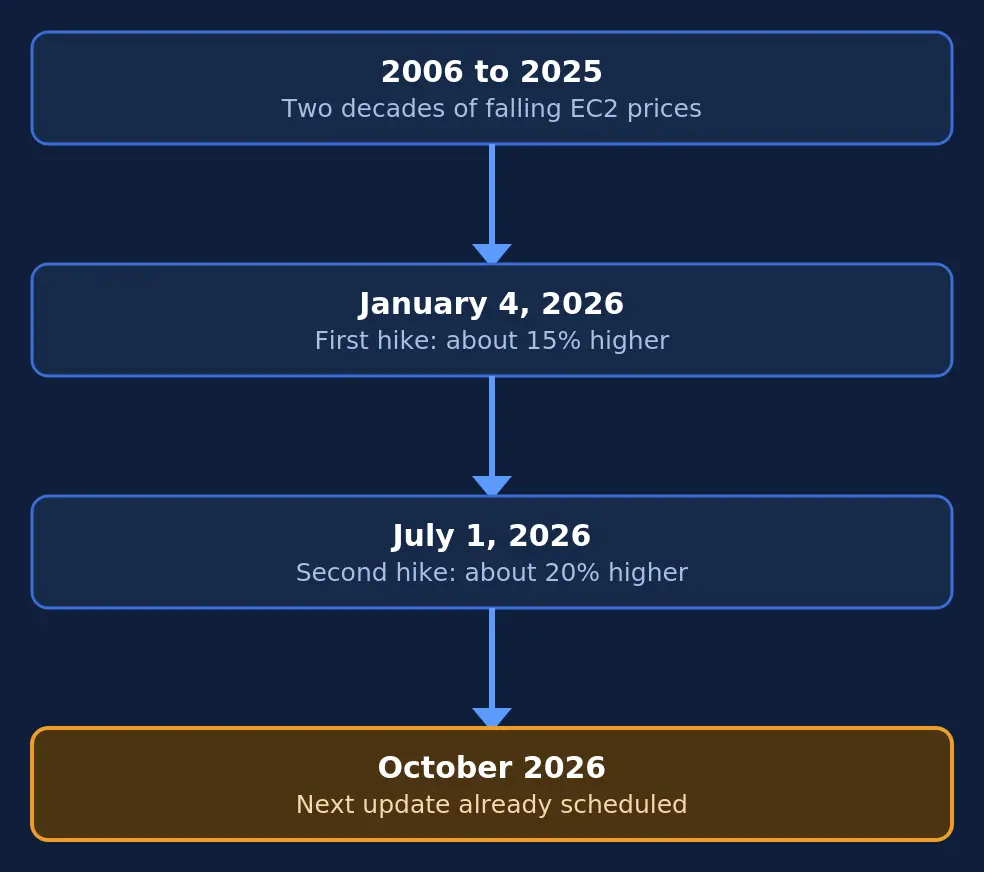
It’s no wonder, therefore, that the price increase in January caught the attention of many industry experts. In fact, different sources mentioned the increase as the first price rise in the history of this product.
Five months after the first price hike, the event happened again, and they completely ruled out any possibility of an anomaly.
How AWS GPU pricing actually works
Not all AWS GPU users bore these price increases equally. The price increase was applicable only to the Capacity Block category, which is a reservation product of AWS offering guaranteed GPU capacity within a certain period.
Pricing models like the price increase have not affected on-demand and Savings Plans, and knowing that will help you decide which pricing model you should choose yourself.
The reason behind the existence of Capacity Block is that there is some extra value in the guaranteed access to scarce GPU capacity. You pay not only for the compute but for the guaranteed access to it as well, which is why AWS can raise the prices in this category.
Reservation periods are available for one day to several months, depending on the particular instance types and their availability. Shorter reservations are normally more expensive compared to longer reservations.
Apart from the reservation cost, AWS charges separately for operating system installation, except for Linux, which is free.
What this means for AI infrastructure buyers
Predictability has become trickier in reserved capacity pricing models. While the rate was steady for years, rates have already increased twice within a single year. AWS plans to introduce a third increase in October.
It could still make sense to secure a reservation under certain circumstances. When you need capacity assurance and expect rates to continue rising, it will always be better to pay the current rate than wait until October.
If you can operate under on-demand pricing terms, then waiting might make sense. There’s a lot of advantage in flexibility when the direction of the trend continues as before.
When you plan to renew or extend any existing AWS Capacity Block commitment, compare the present rate with the one you’ve been paying. The commitment that was made prior to January or July could be outdated at the moment.
Of course, consider the total cost and the initial per-hour cost. Sometimes, a higher per-hour cost with a smaller commitment may be better than a lower per-hour cost with a long commitment. Considering how pricing has changed over the past year, this matters immensely.
AWS isn’t the only choice for your services. For more information on how AWS, GCP, and Azure stack up beyond the price discussion alone, review the full hyperscaler comparison.
Non-hyperscalers also need to be considered. GPU cloud pricing is highly variable for non-hyperscalers. Comparison between various verified options delivers significantly lower costs than a hyperscaler reservation.
Frequently asked questions
How much did AWS raise GPU prices in 2026?
AWS increased the cost of EC2 Capacity Block two times. By 15% in January and by 20% in July. It is clear from AWS’s own page that there is going to be a third update in October 2026.
Why did AWS raise GPU instance pricing?
In terms of explanation, AWS just mentions “periodic pricing updates based on supply and demand.” However, independent analysis suggests increasing demand and limited availability of high-performance GPUs as a cause.
Will AWS GPU prices come down?
This does not appear to have happened yet. AWS’s own page reveals that there is going to be another update in October 2026, but the direction remains unknown. Since the supply and demand pressures haven’t changed, it seems more likely that there will be an increase rather than a decrease.
Does the AWS price increase affect on-demand instances too?
No, AWS restricted both 2026 increases to Capacity Blocks, the reservation offering of AWS. The changes did not affect on-demand prices and savings, although this might change with the upcoming October announcement.
What’s the cheapest alternative to AWS for GPU cloud?
It depends on the GPU and the provider. Both marketplace and managed cloud services usually beat AWS reserved prices, though with some differences in reliability depending on the provider. Checking the current prices directly is always the best option because of how rapidly this market changes.
Do other cloud providers plan similar price increases?
No other provider has confirmed anything similar as of now. Since the same pressure is affecting the entire market in the same way, it is not surprising at all.
GPU prices are rising everywhere, not just at AWS
AWS’s two price increases are the most well-documented case. The underlying force behind their increases is a problem throughout the entire sector: restricted supply meeting increased demand for AI.
More such increases from more providers will continue in the second half of 2026. AWS has scheduled its own October increase, and it may not be the only one this year.
Two things you should monitor. First, whether AWS’s October increase raises prices again or holds steady. Second, whether other hyperscalers raise prices as well, because they all face the same supply issue that AWS faces.
Neither outcome is definitive, but they are definitely worth keeping track of if you have large GPU reservation expenses.
But before purchasing a reservation anywhere, be sure to check current pricing directly. Do not automatically think that your current hyperscaler is the best deal because it used to be half a year ago.
Get personalised, no-commitment quotes from top AI infrastructure providers in under 2 minutes.