NVIDIA has formed a partnership deal with 8 Australian companies on September 9, 2026. They have set a target to achieve up to 2 GW of AI computing capacity by 2027.
This is a figure worth dwelling on for a while. The current footprint of all the data centres in Australia is 1.6 GW. This goal alone will more than double that figure.
However, a gigawatt is not an equal capacity of GPUs. A part of this deal is not entirely new, as well. The following table shows what NVIDIA has announced, what the deal actually means, and if Australia can provide it in time.
Key takeaways
- The partnership deal between NVIDIA and 8 Australian companies, announced on September 9, 2026, targets up to 2 GW of AI computing capacity by 2027.
- This will more than double the current 1.6 GW total footprint of data centres in Australia.
- A gigawatt of capacity doesn’t mean an equal capacity of GPUs. Generation, configuration, and networking reduce the figure.
- A significant part of the announced “2 GW” rebrands existing capacity and deals.
What NVIDIA actually announced
The partnership includes 8 Australian companies: Firmus, Sharon AI, IREN, Megaport, ResetData, CDC, NEXTDC, and AirTrunk. Each one serves a different function in the construction.
The AI Compute Threshold Report
We analyzed pricing from 150+ GPU cloud providers to find the exact threshold where an AI startup's OpenAI API bill eclipses the cost of a dedicated H100 cluster.
Read the Full ReportNVIDIA’s direct contribution comes from its DSX AI factory platform. This includes GPUs, the networking stack, and the overall software ecosystem for connecting the facility.
All other tasks fall to the Australian partners. They will be responsible for the construction, management, and operation of the facilities themselves.
Each company provides something different. The Megaport contributes network connectivity infrastructure that connects facilities to each other.
NEXTDC and AirTrunk provide experience in managing data centres, as they have been operating large-scale data centres in Australia for years. ResetData and CDC add additional capacity to that mix.
The “2GW up to 2027” number itself is a target. It is not an actual built and verified number. NVIDIA’s own announcement defines it as such.
It is important to understand that difference, as it is crucial for the following text in the article.
The coverage of the announcement focused on the headline number, with little questioning of what “2GW” means. Almost nobody has tried to look at that number from a slightly different angle.
Why a gigawatt isn’t the same as usable GPU capacity
This is the portion usually overlooked in coverage. But forms the substance of the headline figure.
The capacity of power versus the capacity of deployable GPUs are not the same measure. The power capacity is the maximum electrical power a facility can use, while the capacity of deployed GPUs refers to the actual number of GPUs used and powered within the facility.
Actual facilities lose capacity to overhead without ever installing any GPUs yet. Cooling systems reduce capacity.
Power conversion reduces capacity. So do redundancy requirements for reliability.
The type of generation and GPU configurations are also key considerations, along with power itself. Building a facility based on current Blackwell GPUs would deliver a different amount of compute capacity than building one using an older generation of hardware.
This is even when both facilities draw the same amount of power. Every megawatt in this announcement won’t always house new GPUs.
Network, storage, and cooling systems are other important considerations. A GPU cluster requires ultra-fast chip interconnects to operate effectively in training and inference of AI models. A facility can have plenty of power but lack network capacity.
Storage throughput is relevant as well, especially when considering training jobs that circulate data in and out of the GPUs. An infrastructure designed to maximise power delivery and not storage capacity will fall short of achieving maximum compute capacity.
This does not intend to suggest that anyone is using the 2GW capacity misleadingly to deceive. The industry typically describes scale in this manner.
The figure nonetheless translates into significantly less deployable AI compute than a superficial reading of the headlines would lead one to believe.
Consider how the engine displacement of a car engine does not equal its power output on the highway. The latter accounts for various factors, including friction that affects the output of the former.
The power capacity of the data centre is no different, as the 2GW capacity describes what the facilities can draw, not the working, deployable AI compute capacity after accounting for various losses along the way.
It is worth looking out for this distinction in all major AI infrastructure deals, not just this one.
How much of this is actually new
They had agreed on part of what 2GW included even before the September announcement.
The deal between Sharon AI and NVIDIA, for instance, dates back to June 2026. Sharon AI valued the deal at up to $4.88 billion and covered the installation of thousands of NVIDIA GPUs even before announcing the larger partnership.
The IREN contribution lies in the 800MW Bundey campus in South Australia. This project was already in progress even before September 9.
CDC contributed 550MW of operational power, together with 800MW currently being constructed. They both precede this announcement.
It is important to highlight Firmus for a brief discussion. The firm separately signed an agreement to supply OpenAI with compute power from two sites in Malaysia.
This has nothing to do with this particular Australia-focused 2GW project. Reporting on the announcement clarifies that this is easy to mix up, as it involves Firmus and high power numbers in both cases.
This is not at all a criticism of the announcement. Packaging old momentum and new commitments together is a regular way of framing such a partnership. This makes the real capacity increase from September 9th somewhat lower than the 2GW number implies.
This is, in fact, a helpful way to look at announcements about large infrastructure. Businesses will always try to package ongoing projects as part of a larger and more recent-sounding partnership when there is indeed an important connection here.
This does not make the announcement false. It just means that the real delta is harder to find than the headline number.
Can the grid actually deliver this by 2027?
Putting aside the distinction between power capabilities and GPU capability considerations, the true limiting factor is something else altogether. Australia’s electricity grid might actually be the real limiting factor.
The Australian Energy Market Operator (AEMO), which monitors these details, reports that the grid connections will total 66.9 GW through June 2026. Notice that these are just requests, not approvals or completions.
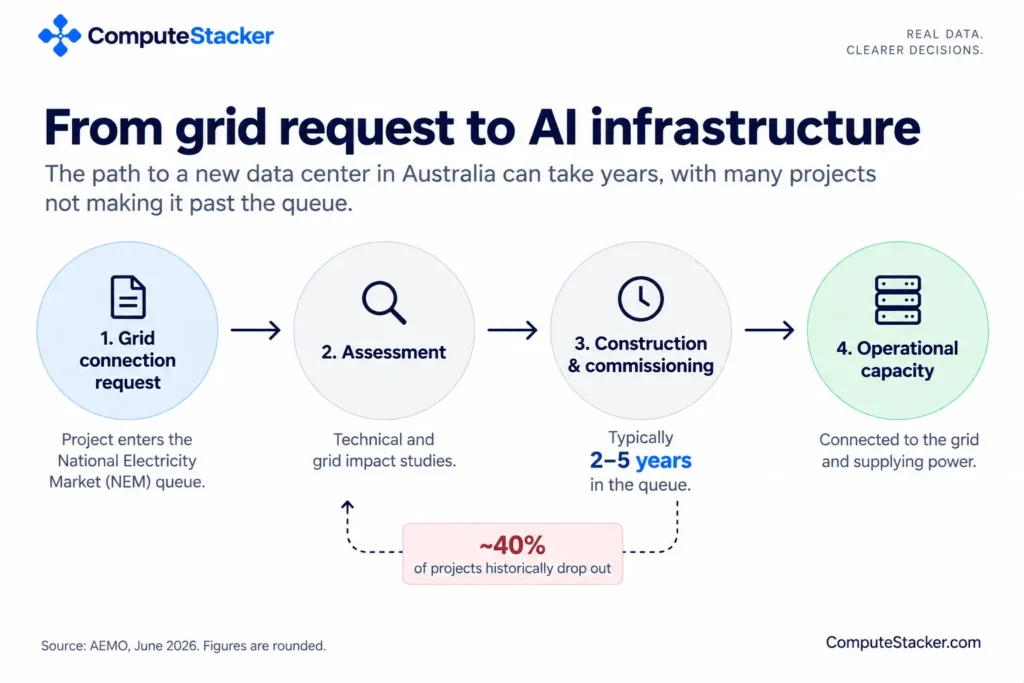
Based on experience, this doesn’t bode well for those hoping for quick turnarounds. Around 40% of all grid connection projects drop out prior to completion, while those that complete often find themselves in interconnection queues that stretch two to five years.
None of this, of course, means that this target of 2GW will fail to come to fruition. However, we must critically scrutinise the timeline set for 2027.
What this means for Sydney GPU capacity and buyers
This news ties in directly with the current GPU capacity landscape in Sydney. This report covers the sovereign and neocloud providers currently present in this market.
Not all 8 partners mentioned have significance specifically to Sydney. For example, IREN’s campus sits in South Australia, so it does not qualify as being in Sydney.
For evaluating Sydney GPU capacity, buyers should note the number of partners building in Sydney rather than the national capacity landscape.
Buyers who are following this news will take away from it the need to be patient and skeptical. We should note that this news will not affect the supply situation for Sydney in the immediate future.
Both the power capacity distinction and the above-mentioned information about grid connections lead to the same conclusion. The realistic timeline will stretch beyond the announced 2027 date.
The pricing ramifications of the news are still unclear. Increased capacity in the market due to increased supply will help with the capacity crunch covered in ComputeStacker’s Sydney capacity story.
Frequently asked questions
What did NVIDIA actually announce for Australia?
A partnership with 8 Australian companies, focusing on a goal of up to 2 GW of AI compute power by 2027. NVIDIA provides the DSX platform. Partners manage construction and operation.
Is the 2GW capacity already built, or still a target?
Definitely still a goal. In the NVIDIA press release, it says 2GW is a target the partnership is trying to reach.
Which companies does NVIDIA’s Australia buildout involve?
Firms include Firmus, Sharon AI, IREN, Megaport, ResetData, CDC, NEXTDC, and AirTrunk, along with NVIDIA.
Will Australia’s power grid be able to support this by 2027?
Definitely an open question. According to AEMO figures, there are 66.9 GW of connection requests for the power grid. Factor in a 40% historical dropout rate and two to five years of interconnection waiting times.
How does this affect GPU cloud capacity in Sydney specifically?
No way. Some partners in this press release operate outside of Sydney. This suggests that there will be more time until 2027 than implied by the headline.
Is any part of this 2GW figure genuinely new, or is all of it pre-existing?
It is a combination of both. The contract for Sharon AI, the Bundey campus of IREN, and the already available capacity of CDC all predate the September announcement.
What to watch next
The September 9 announcement marks just the beginning of the story, not the end. What will really happen will become clear in the following years.
Watch out for partner-specific construction developments, particularly from those providers that have their actual operations in Sydney. Watch out as well for the progress of AEMO in the grid connection of the projects involved in this partnership. Also, be on the lookout for how many of the constructed capacities become current-generation GPU computing capacities and not older hardware.
It is important to monitor pricing signals as well. The actual availability of new capacity in Sydney is the only time when capacity crunch issues covered elsewhere on this site might actually ease up. Until then, pricing optimism related to this announcement is premature.
Also note that it is possible there may be additional clarification on the amount of new capacity compared to the existing capacity from NVIDIA or even any of its 8 partners. The information will answer the “how much is new” question accurately, rather than just from the public statements available.
The announced capacity will seldom be the same as the delivered capacity.
And it also tends not to be delivered on schedule. That tendency is true for almost all significant AI infrastructure announcements made so far this year. There are no reasons to think that this case will be an exception.
Compare the current capacity and pricing of GPUs from reliable providers to get the actual situation regarding capacity.
Get personalised, no-commitment quotes from top AI infrastructure providers in under 2 minutes.