Look up the cost of RunPod’s H100 GPU cloud service in five articles related to “the cheapest GPU cloud,” and you will receive different prices in each article, ranging from $1.99 to $3.49 per hour. The range for Vast.ai varies from $1.40 to $2.27 per hour.
Each source claims these lists are up-to-date. However, this is not a mistake in the data. This is how “cheapest GPU cloud” works, and this aspect is more important than any single price.
Below are the actual differences in prices among these services:
| Provider (H100) | Quoted rate | Source |
|---|---|---|
| RunPod | $1.99/hr | CloudZero |
| RunPod | $2.89/hr | GPUCost |
| RunPod | $3.35/hr | Northflank |
| RunPod | $3.49/hr | Thunder Compute |
| Vast.ai | $1.40/hr | GetDeploying |
| Vast.ai | $1.77/hr | Northflank |
| Vast.ai | $2.21/hr | Thunder Compute |
| Vast.ai | $2.27/hr | CloudZero |
The same providers, the same GPU model, almost the same timeframe. The variation itself speaks to the inconsistency of those prices.
The AI Compute Threshold Report
We analyzed pricing from 150+ GPU cloud providers to find the exact threshold where an AI startup's OpenAI API bill eclipses the cost of a dedicated H100 cluster.
Read the Full ReportKey takeaways
- There is no single vendor that is always the least expensive; it all comes down to the GPU type, billing mode, geographic location, and comparison of spot and on-demand pricing.
- Tables published about “the cheapest GPU cloud” typically vary by 50% or more for the same vendor’s GPU.
- Marketplaces such as Vast.ai will publish the lowest price figures at the expense of reliability.
- Providers like RunPod and Lambda lie somewhere in the middle with stable pricing and good reliability.
- The hyperscaler clouds do not have the lowest pricing for on-demand, but they are close for spot.
Why “cheapest GPU cloud” lists disagree so much
These four factors mainly contribute to the controversy, and none of them is hard to comprehend.
First, many of the tables include both spot and on-demand pricing without making distinctions between them. There can be a difference of over 50% between the spot and on-demand prices for the same GPU. This makes the “cheapest” condition obsolete.
Second, the “H100” label is not specific. SXM and PCIe versions of the same chip have different price. Different hourly prices for the same GPU make the quote irrelevant.
Finally, there is the always-changing marketplace pricing. Vast.ai provides peer-to-peer GPU services, and the current rate can become irrelevant soon. Therefore, even up-to-date information loses its relevance right after publication.
Publication dates are just as important, but other lists often neglect them. The relevant information provided in May might not be relevant anymore by September.
The three tiers of GPU cloud pricing
It is possible to distinguish providers into three broad tiers in order to make this dispute simpler to analyse without finding a universally agreed number.
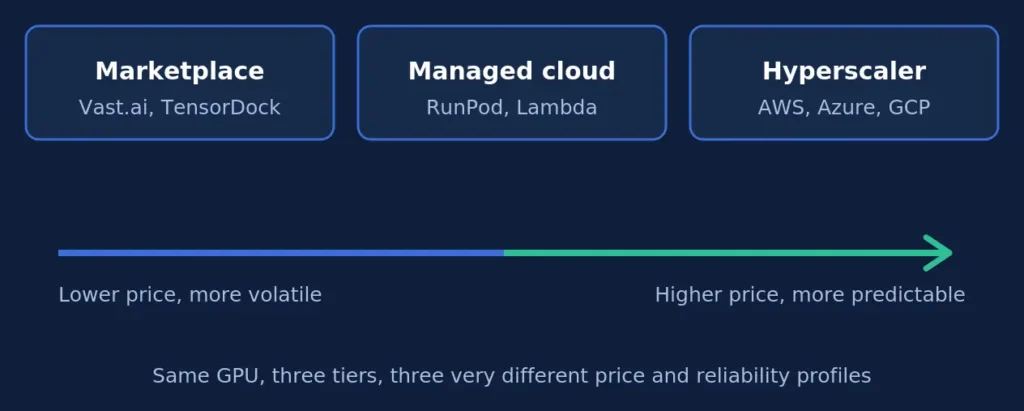
The cheapest providers such as Vast.ai and TensorDock belong to the lowest tier. They function in a manner similar to a peer-to-peer market, connecting hardware owners to renters. The price changes according to market conditions, which GetDeploying’s live tracking, making the difference in quotes understandable.
Managed cloud providers such as RunPod, Lambda, and Thunder Compute represent the middle tier. These providers own their hardware and provide predictable uptime. Norhtflank’s own pricing comparison reflects this stability, with prices higher than marketplaces and much more stable.
On the other hand, hyperscalers such as AWS, Azure, and GCP offer the highest prices for on-demand pricing. However, spot and preemptible tiers offered by hyperscalers often beat managed clouds in price. The availability of these resources remains uncertain.
Distinguishing the tier to which each number belongs provides answers to many questions about the dispute itself. The prices provided by marketplaces and hyperscaler on-demand services were bound to differ, even for an identical GPU.
Why the GPU generation changes the comparison too
The tier of the provider is not the only aspect that you should be careful with. The generation of GPU you compare matters as well, and another way the “cheapest” lists fool is by comparing different generations.
The producers priced the previous generation of GPUs, A100s, substantially lower than H100s in nearly every tier. Newer technology always costs more until the following generation distracts attention from it.
B200s, the newest generation of GPUs that you can get, have the highest prices, even multiple times an H100’s price. Availability is still low for the time being, which pushes prices up.
This matters for price comparisons. Comparing the low price of A100 to the high price of H100 in a cross-generational price comparison list will lead to misleading conclusions regarding what is “cheapest.”
Make sure that you always compare prices of the same generation.
What a “cheapest” number usually leaves out
The rate advertised isn’t always the full price tag. Additional charges for egress and storage typically remain outside the advertised cost in almost every marketplace.
The price of data transfer will usually come as a shock to you. An hourly GPU rate does not reveal the cost incurred in transferring large model weights or datasets to/from the provider’s network upfront.
There is a storage fee as well. A majority of provides levy additional costs for storage provision associated with the GPU rate itself.
The minimum commitment duration is an important factor as well. A combination of a low hourly rate and a lengthy minimum commitment period will end up costing you more. The slightly higher rate without the commitment is therefore often the better choice.
Reliability, however, is the highest hidden cost of all. Marketplace/spot tiers have the lowest headline rates since providers can repossess the resources easily.
How to actually evaluate GPU cloud pricing yourself
Avoid searching for one solution that fits all. Use these steps.
First, specify your workload. An experiment, a long training run, and an inference service are interruptible to very different degrees. This amount of tolerance will allow you to select the proper pricing tier.
Specify your billing model depending on your workload. Spot instances are perfect for those workloads that tolerate interruptions, such as batch processing or checkpointing during a training run.
A production workload requires on-demand or reserved instances because interruption is much more expensive than the cost savings.
Compare only comparable instances. Just because you have an estimate of “H100” without mentioning its memory, interconnection, and region does not make it a comparison. Two instances called “H100” may be totally different systems.
Finally, consider prices at the moment of renting. Comparing the prices of several vendors on one website is much quicker than visiting each website. Also, even aggregated prices may be out of date.
Frequently asked questions
What is the cheapest GPU cloud?
It does not have one. Marketplaces such as Vast.ai always post the lowest prices. However, managed services like RunPod and Lambda accept a small premium for reliable operation.
Who is the cheapest GPU cloud provider?
It varies depending on the GPU model and billing. Peer-to-peer marketplaces normally provide the best prices, while managed cloud provides reliable service at slightly higher but competitive prices.
What’s the cheapest cloud option for renting an H100?
Marketplace platforms are normally cheap in H100s. However, pricing is dependent on SXM versus PCIe and changes quite often. Please check prices in real time.
What’s the cheapest cloud option for renting an A100?
Just like the H100. Prices posted by marketplaces are the lowest, with managed service providers providing slightly higher but reliable pricing.
Is a GPU marketplace like Vast.ai actually cheaper than a managed provider?
Yes, most of the time. But the cost is reliability. Providers may interrupt at any time because of marketplace capacity. It is not suitable for work that cannot tolerate downtime.
Is cloud GPU pricing cheaper for machine learning than buying hardware outright?
Yes, although only initially. Cloud rental does not incur the expense of purchasing the GPUs outright, although intensive use over a sufficiently long period could favour ownership eventually, depending on the task.
How does GPU cloud pricing compare to running the same job on AWS?
AWS tends not to be the most economical on-demand cloud service provider for GPU access. Spot instances significantly reduce this difference, although users cannot rely on them as much as on-demand instances.
Does the cheapest GPU cloud rate stay the same over time?
No. Prices, particularly for the marketplace, are prone to change in days as demand and supply fluctuate, even for managed-cloud and hyperscaler services. Older generations of hardware drive older capacity to become cheaper.
The real answer isn’t a fixed number
Each “cheapest GPU cloud” list can’t agree with the following one since the market itself constantly grows. It includes emerging hardware generations, emerging vendors, and changing prices; therefore, any static snapshot quickly becomes outdated.
It applies to the data used above in the table. The numbers there are just an example of various sources reporting what happened during some period, but definitely not an eternal ranking.
What matters is not which list to rely on, but which approach to use. Specify your workloads and choose an appropriate billing model; ensure that you compare identical GPUs from the same generation.
Next, compare vendors all in one place and confirm the precise price with the chosen one.
It will work regardless of who offers cheaper services that very week.
Get personalised, no-commitment quotes from top AI infrastructure providers in under 2 minutes.