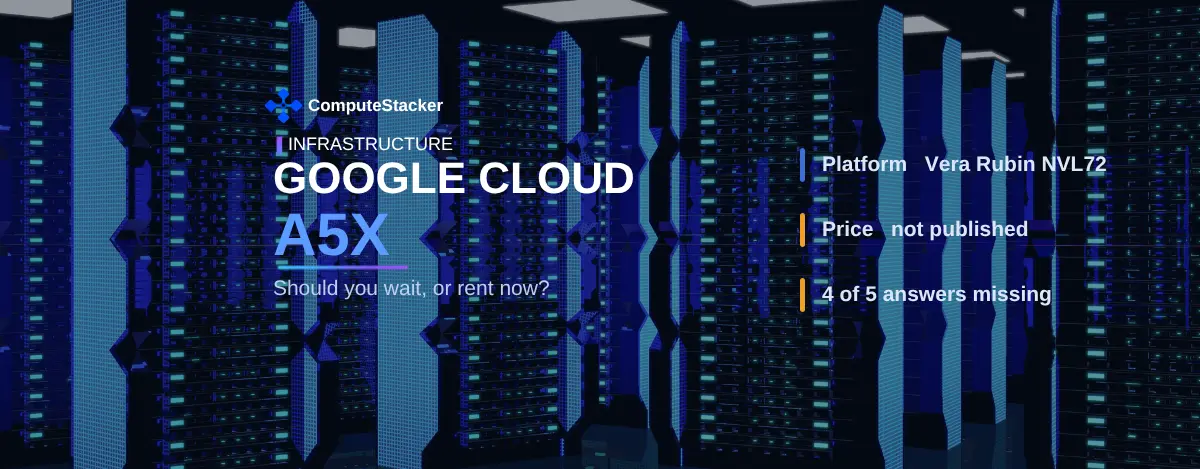
Google Cloud introduced A5X on 21 October 2026. This is a novel rentable machine that has been built using NVIDIA’s recent GPU platform.
Here is a quick response to Google Cloud’s A5X. If your project requires you to have a full rack of GPUs, but your schedule allows for a delay, wait. Use whatever is available right now if you cannot afford to delay.
There is, however, a catch in this response. Google has not revealed the price, number of GPUs, or date of release.
Key takeaways
- A5X is a Google Cloud instance that runs on the NVIDIA Vera Rubin NVL72. The instance and Google Cloud Platform are not competing products.
- Google has yet to announce any of the five numbers that an interested buyer should know. These include GPUs per instance, memory, network bandwidth, pricing, and release date.
- Both announcements make it clear that general availability is “coming next month,” but neither announces a specific date.
- The networking and storage improvements are much more important than the GPU for long context-based agentics.
- Two customers have tested this instance. Neither is a benchmark that has been published.
What Google Cloud A5X actually includes
The announcement was made by Google Cloud and NVIDIA at GTC Berlin on 21 October 2026. Google Cloud A5X is a bare-metal instance.
The AI Compute Threshold Report
We analyzed pricing from 150+ GPU cloud providers to find the exact threshold where an AI startup's OpenAI API bill eclipses the cost of a dedicated H100 cluster.
Read the Full ReportBare metal, in simple words, refers to renting the entire physical server. There is no virtualisation layer between the server and the code, and you are the only customer on that machine.
Four elements comprise the system, as per the NVIDIA announcement. The Vera Rubin NVL72 platform offers the GPUs, whereas the NVIDIA ConnectX-9 SuperNICs offer networking capabilities.
In simple terms, a SuperNIC refers to the network card that transfers data from one server to another. In the case of AI clusters, it does much more than a normal NIC due to the load of training jobs.
Virgo is Google’s network in Google Cloud that allows machines to communicate with each other. The fourth-generation liquid cooling feature prevents the machines from overheating.
Generally available is stated as “coming next month”. Furthermore, Google is growing, introducing new local regions, and thus allowing its European customers to store data in their jurisdiction.
In simple terms, data residency means the geographical location of the data in a particular region/country. Data residency is frequently required in regulated industries.
Orchestration gains two new capabilities for those who run Kubernetes. There are Managed DRANET and Kueue in Google Kubernetes Engine.
In simple terms, DRANET makes network cards managed by Kubernetes. Kueue schedules jobs considering the network topology, i.e., moves jobs together.
What Google has not published
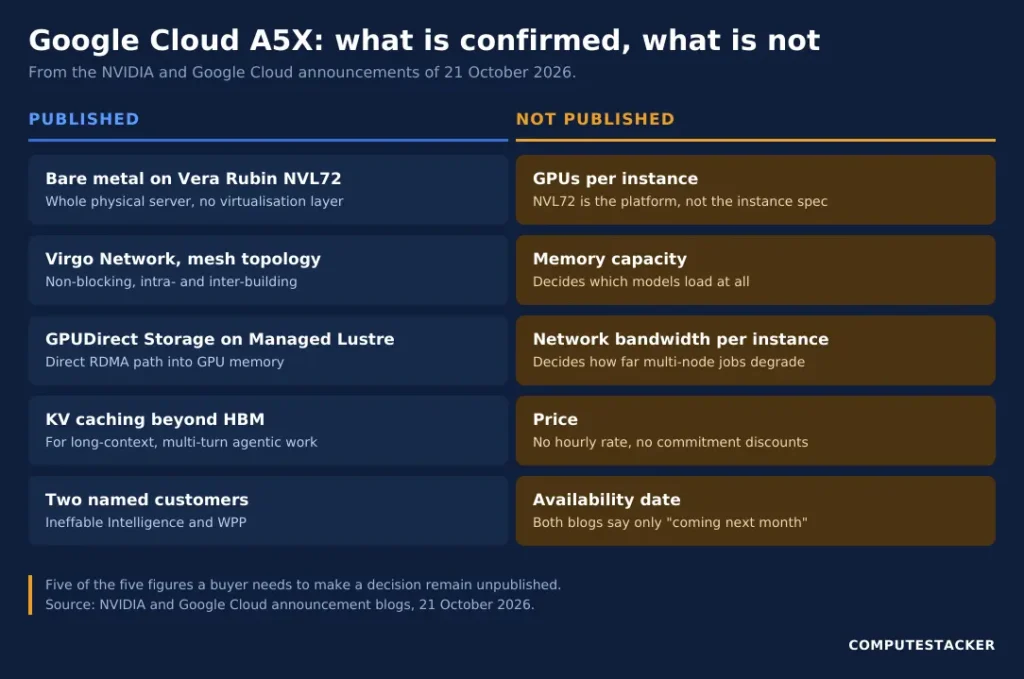
That’s where all the other write-ups fell short. Five pieces of information tell whether or not a computer is right for you, and Google failed to provide any.
| What you need to know | Published? | Why it matters |
|---|---|---|
| GPUs per A5X instance | No | Decides whether your model fits without crossing to a second machine |
| Memory capacity | No | Decides which model sizes you can load at all |
| Network bandwidth per instance | No | Decides how badly multi-machine jobs slow down |
| Price | No | Decides everything else |
| General availability date | No | “Next month” is a direction, not a date you can plan around |
Nothing here makes A5X a bad choice, either. It makes A5X an unquantifiable choice.
An investor cannot evaluate an unquantifiable choice when they have a quantified, priced choice at hand to rent today. That’s what’s really behind the case for not waiting.
What “built on Vera Rubin NVL72” does and does not tell you
First, let’s clear up the misconception caused by misleading headlines. Google Cloud A5X is not an alternative to Vera Rubin. A5X is the product name for the machines featuring Vera Rubin.
NVL72 is a description of NVIDIA wiring.
In simple words, NVL72 is 72 GPUs wired in such a way that each GPU can communicate with any other GPU at full capacity. The term used in the industry is rack-scale, meaning that the unit of sale is a rack, and not a server.
This is where people get confused. The platform features 72 GPUs, and therefore people conclude that one A5X instance will feature 72 GPUs.
Google and NVIDIA do not say that. They only discuss the platform in their announcements.
However, there is one indication of rack scale. WPP claimed that some tasks that typically required a multi-node cluster could run on a single A5X instance. This is not a specification, and you should not plan budgets according to this information.
For more information about the platform itself and CoreWeave deployment, refer to our article about Vera Rubin on CoreWeave. For more information about the interconnect in the NVL72, read our article about what NVL72 connects.
The networking and storage changes matter more than you think
Most of the articles centred on the GPU. In the case of agentic work, for which context is necessary, the complementary articles might be more important.
To explain in simple terms: Agentic work is an AI process in which the AI takes several steps in order. It invokes functions and uses previous context rather than replying just once.
According to the announcement made by Google Cloud, the Virgo Network follows the non-blocking mesh architecture.
To put it simply: non-blocking means that each machine can send at full speed simultaneously. There is no queuing of machines waiting for other machines to finish sending data.
According to Google, this will help in growing the clusters up to 80,000 Rubin GPUs at one location and 960,000 in multiple locations. Note that both figures mentioned are targets.
Storage gets direct access to the GPU via GPUDirect Storage. The new version of Google Cloud Managed Lustre will support NVIDIA GPUDirect Storage for A5X instances.
In simple terms: normally, data flows from storage to the CPU and to system memory and finally to the GPU memory. GPUDirect Storage does not have any intermediate steps and sends data directly to GPU memory.
Context caching gets more space. According to Google, caching will allow scaling the context memory above GPU HBM.
In simple words: GPU HBM is the fast memory available next to each GPU, and its size is small. A conversation long enough can fill this cache. Spilling this cache to storage allows storing more history.
According to Google, it reduces time-to-first-token and improves inference goodput per dollar of cost. Time-to-first-token is the period until text starts appearing for users. Goodput measures only successful operations without reattempts.
Where Google Cloud A5X sits in the lineup
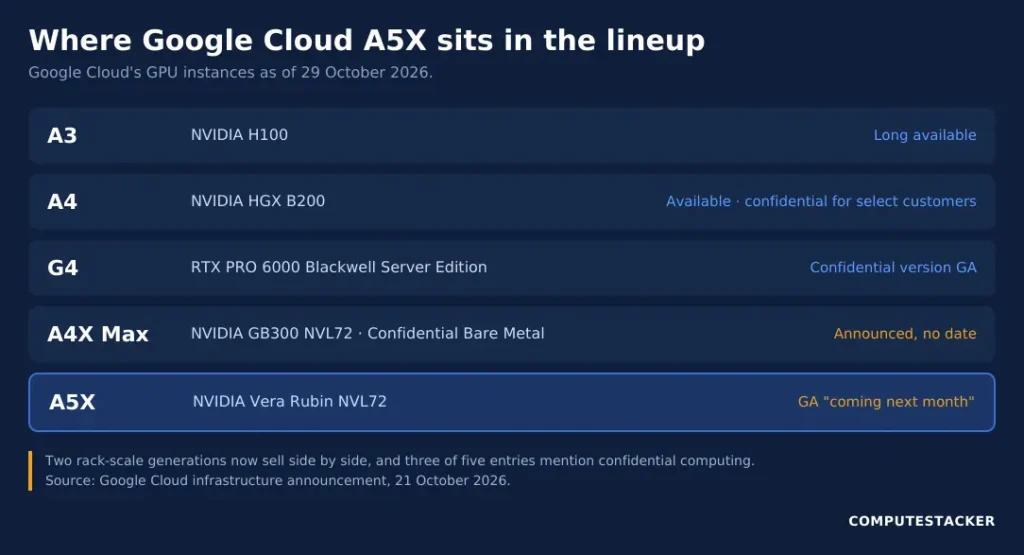
A5X is part of the lineup rather than a replacement for one. The knowledge of the sequence will enable you to choose an alternative if need be.
| Instance | Hardware | Status as of 28 October 2026 |
|---|---|---|
| A3 | NVIDIA H100 | Long available |
| A4 | NVIDIA HGX B200 | Available; confidential computing with Intel TDX for select customers |
| G4 | RTX PRO 6000 Blackwell Server Edition | Confidential version generally available |
| A4X Max | NVIDIA GB300 NVL72 | Announced, with NVIDIA Confidential Bare Metal. No date given |
| A5X | NVIDIA Vera Rubin NVL72 | General availability “coming next month” |
There are two common themes here. One is that Google has shifted from offering single servers to rack-scale servers in two generations called A4X Max and A5X.
Confidentiality is another theme evident from the fact that three out of five of these listings speak about confidential computing.
Our comparison of B200 with H100 will cover this transition of generation.
Who is already using it?
Two customers are featured in the press releases. Each tells you something, although neither has disclosed any numbers.
Ineffable Intelligence, the UK-based company founded by David Silver, got access first. It used large-scale reinforcement learning.
In layman’s terms: reinforcement learning involves training a model based on trial and error rather than a static dataset. Reinforcement learning is long and requires continuous high-performance computing.
WPP used NVIDIA Nemotron models to create a creative agent system that checks the video frame and adjusts the brand assets.
It is the second case that is more interesting. What usually took several computers can now be performed by just one. Which means that it is a large-scale instance; however, Google didn’t disclose any numbers about that.
Consider both as intent signals, not benchmarking results. The vendor press release mentions the customers that behaved nicely.
Should you wait or rent now?
This will depend on your workload characteristics. This is what the decision tree implies.
Don’t do it now if all of them apply to you. You will need rack-scale GPUs, and you won’t be able to make it work with just eight. You are adaptable enough to tolerate a delay of one month.
However, you must have the capability to do a benchmark first. Waiting without benchmarking just delays your risks.
Go ahead and rent immediately if any of the following applies. You need to start working on this project this quarter, or your model can run on existing hardware. And the final reason to go is that you have a financial department that requires the price first to approve the purchase.
The last criterion applies in the majority of cases. You can hardly make a business case without knowing the price point.
Be careful with the fourth one, which seems attractive initially.
But this will hold only after you know the price. An unpriced computer cannot be superior in its value to a priced one, as value needs two components.
Let’s say that the team adjusts a 70-billion-parameter model in January. There is no challenge for modern hardware, and you have nothing to wait for.
Now, let’s think about a team that trains an experimental model next year. With hundreds of GPUs, the interconnect matters and waiting one month makes sense.
The vast majority of teams will look like the former much more than the latter.
There is a middle ground. Start where you’re at now, with existing hardware, and make your work portable. Containerised work is much easier to migrate from one instance type than work that’s machine-specific.
Still, people who do choose to wait must see what they might get right now. Capacity issues sting more than hardware generation for the vast majority of teams, which we cover in our GPU capacity guide.
Choosing between Google Cloud, AWS, and Azure rarely hinges on a single instance type. We address it in our AI hyperscaler comparison.
What to ask Google before you commit
Five questions convert an announcement into a decision. Each is tied to one of the five hidden numbers.
- How many GPUs does an instance of A5X have, and how much memory does it hold?
- What does the cost per hour amount to when you use it on-demand, and what discounts do they offer for commitment?
- In which regions will A5X be made available on general availability, and in which regions later?
- What bandwidth does one instance have to communicate with other instances?
- Can we test our own workload before committing?
Start by asking the fifth question. An offer to do testing is a message to you.
Cross-check the answers with our own Google Cloud GPU choices catalogue. Find out what the metric of GPU-hour means.
FAQ
Is A5X the same thing as Vera Rubin?
Not quite, and the distinction matters. Vera Rubin NVL72 is NVIDIA’s hardware platform, and Google Cloud A5X is the product name for instances built on it. You rent an A5X rather than “a Vera Rubin”.
How many GPUs are in one A5X instance?
Google has not said. The NVL72 platform connects 72 GPUs, but that describes the platform, not the instance. Assuming 72 could leave you badly wrong on both capacity and cost, so ask before you plan.
Has Google published Google Cloud A5X pricing?
No. Neither announcement mentions price, and no commitment discounts have appeared. Until Google publishes, compare on the specifications you can verify elsewhere.
Can I get A5X outside the United States?
Google says new local regions are coming to support EMEA data residency and sovereignty requirements. It has not named them. If a specific country matters to you, that is a question for your account team.
How is A5X different from A4X Max?
A5X runs Vera Rubin NVL72, while A4X Max runs the earlier GB300 NVL72. A4X Max adds NVIDIA Confidential Bare Metal, which keeps your data encrypted during processing.
Choose A4X Max if confidentiality outranks raw performance for your workload.
Conclusion
Google Cloud A5X is real, two customers have run work on it, and general availability arrives soon. What it costs and what it contains remain unknown.
Those unknowns should decide your timing. A machine you cannot price is a machine you cannot plan around, however good the hardware turns out to be.
Send Google the five questions above. If the answers arrive before your project needs to start, reconsider. If they do not, rent what you can measure today.
Get personalised, no-commitment quotes from top AI infrastructure providers in under 2 minutes.