Creating an AI application is not just about writing code. The design, data processing, model access and server costs involved all have to be paid for. Most companies forget to account for the ongoing costs that come with an AI application upon launch.
This is one of the key differences in the AI application budget. The cost of development is a one-off expense in the creation of the application, while the operational cost is incurred every month.
The costs of APIs and cloud infrastructure are mainly operational costs. This copy explains how much it costs to create an AI application with the approximate monthly cost in place.
How much does AI app development cost?
Although there is no specified price, the estimations made by the agency fall into three categories. The prices provided here are based on the data acquired from the guides published by agencies in the year 2026. It is better to treat them as a range that is reasonable to depend on rather than as an exact amount.
The AI Compute Threshold Report
We analyzed pricing from 150+ GPU cloud providers to find the exact threshold where an AI startup's OpenAI API bill eclipses the cost of a dedicated H100 cluster.
Read the Full Report| App type | Typical build cost | What you get |
|---|---|---|
| Basic AI integration or MVP | $15,000 – $50,000 | A chatbot or single AI feature built on a hosted model API |
| Production AI application | $40,000 – $180,000 | Custom UI, data pipelines, several AI features, integrations |
| Enterprise AI platform | $150,000 – $400,000+ | Multiple systems, strict security, compliance, custom models |
Most of their applications cost between $40k to $180k. Technource charges between $150k to $400k and up for enterprise level applications. RapidDev charges between $15k to $50k to build your MVP using a hosted solution such as Claude or GPT.
Assumptions behind these ranges: It is important to know that the prices shown in the estimations clearly represent outsourced work and more often than not refer to American rates. The figures deal with the expenses associated with the development of the AI application and do not include costs connected with hosting and using the APIs.
Three factors explain most of the gap between tiers.
Are you using a hosted model or training your own? How clean is your data? How many systems will the app need to integrate with?
What goes into the total cost of building an AI app?
A budget has five main components. Each one can swing the total by tens of thousands of dollars.
UI/UX design and development
Users will still need to view screens, log in, pay and configure settings. These are normal features of an app, and can often be the biggest part of an engineers time. Chat interfaces can seem simple, however streaming responses and error states can be more difficult.
AI model selection and API integration
Your team will select a model, write prompts, and integrate your application with your provider. You will also have guardrails, fallbacks and logging. If you make your solution model agnostic, then you can switch models later on more cheaply.
Data preparation and storage
Many AI applications can be used to answer questions based on company documents. This involves data wrangling, chunking and putting into a vector database. One of the most common causes of exceeding budget is messy data.
Testing, deployment and security
AI will produce different outputs based on its input. Teams will look at the AI’s answers to ensure they are accurate, safe and appropriate. In regulated industries there will also be more checks such as audits, access controls and data residency.
Ongoing maintenance
As models are regularly updated or decommissioned, plus prompts shift depending on user behaviours, there needs to be monitoring and fixing of issues. This can be a costly process to carry out as salaries for AI/ML engineers in the USA are around $134,000-$193,000.
AI model pricing: API vs Self-Hosted models
This will affect how much you pay to run your models. You can either pay for intelligence on a per token basis or run an open weight model on your own GPUs.
Third-party APIs and token pricing
Based on how many millions of tokens you use. Input and output tokens have different prices. Tokens are around 3/4 of a word. Output tokens are several times more expensive than input tokens.
| Model | Input (per 1M tokens) | Output (per 1M tokens) |
|---|---|---|
| OpenAI GPT-5.5 | $5.00 | $30.00 |
| OpenAI GPT-5.4 | $2.50 | $15.00 |
| OpenAI GPT-5.4 mini | $0.75 | $4.50 |
| Anthropic Claude Sonnet 5.5 | $2.00 | $10.00 |
Standard-tier list prices, checked November 2026 against OpenAI’s API pricing and Anthropic’s pricing docs. Batch processing halves these rates on both platforms.
APIs need no hardware, no setup and no idle cost. You pay only when users send requests. The trade-off is that your bill rises in a straight line with usage.
Open-weight models and self-hosting
Models like Llama, Qwen, Mistral etc will run on rented (or owned) GPU hardware. You will be charged for the GPU resource but after it’s up and running then additional requests will have no additional cost.
Using self-hosted models means that you have full control of your data. You can fine tune the model as you want, however your team will need to manage serving, scaling and uptime.
When each approach makes financial sense
Start with an API to get started, but if the traffic is low, or erratic, then it’s best to rent an GPU and pay hourly rates. Once the traffic becomes high and consistent, self-hosting becomes more viable.
Sometimes privacy regulations can play a role. Some Healthcare or Finance clients won’t even send data out to a 3rd party API.
Understanding GPU cost and AI infrastructure
If you self-host or train models, GPUs become your largest line item. Knowing what drives their cost helps you avoid overbuying.
Training vs inference
Training teaches a model from data and can need many GPUs for days or weeks. Inference runs the finished model to answer user requests. Most app teams only need inference, and often only one or a few GPUs.
What drives GPU cost
Memory is the first constraint. At 16-bit precision, a model needs about 2 bytes of GPU memory per parameter. An 8-billion-parameter model needs roughly 16 GB, while a 70-billion model needs about 140 GB before overhead.
Workload and GPU utilisation matter just as much. An idle cheap GPU can cost more per useful hour than a pricier one kept busy.
H100, A100 and RTX 4090 examples
| GPU | Memory | Typical fit | RunPod on-demand rate |
|---|---|---|---|
| NVIDIA H100 (PCIe) | 80 GB | Large models, fast inference, training | $1.99 – $2.89/hr |
| NVIDIA A100 (PCIe) | 80 GB | Mid-size models, fine-tuning | $1.19 – $1.79/hr |
| NVIDIA RTX 4090 | 24 GB | Small models, image generation, testing | From $0.34/hr |
Rates from RunPod’s GPU pricing page, Community to Secure Cloud tiers, checked November 2026. Rates change often.
For help matching a model to hardware, see our guide on choosing the right GPU.
GPU server cost and AI infrastructure cost
The GPU will need a host server containing CPU’s, RAM, fast storage and networking. When using more than one GPU for training you will also need high-speed interconnects which again increases costs.
Storage costs are also included within your total AI infrastructure costs. Different providers will charge for egress or ask for minimums. We explain in more depth all the hidden costs of using GPUs in the cloud.
GPU cloud pricing vs buying your own GPU
Renting turns hardware into an hourly expense. Buying turns it into a large upfront investment that you must keep busy to justify.
What it costs to buy
A new H100 sells for about $25,000 to $40,000, depending on the variant. PCIe cards sit at the lower end, while SXM modules sit higher. For smaller work, the RTX 4090 launched at $1,599 but offers only 24 GB of memory.
Hourly and monthly GPU cloud pricing
Cloud GPUs are charged per hour/second. Using one H100 PCIe on RunPod’s Secure Cloud ($2.89) will cost you approximately $2,110 for the full 730 hours. On Community Cloud ($1.99) using one H100 PCIe will cost you approximately $1,453.
Electricity, cooling and maintenance
The H100 SXM requires up to 700W of power (NVIDIA H100 datasheet). If used 24/7 this requires around 511 kWh a month.
Taking into account the average cost of electricity in the US at ~14 cents a kWh (EIA Electricity Data). This means each GPU would cost ~$72 a month to run. This does not take into account cooling, server, rack space and man power.
When cloud rental is more economical
If you compare the $25,000 H100 PCIe with the $2.89 hourly rental price, it will take around 8,650 rental hours for you to break even on the card alone. This is almost 12 months of continuous use and doesn’t include any servers, power or people.
Taking 50% utilisation into account, you are looking at around 2 years to break even. During this time rental prices will have dropped further due to newer GPUs being available. For the majority of startups/app teams renting is the safest option.
How much does it cost to run an AI app monthly?
Monthly running costs depend on your usage. There are often 5 key areas of spend:
- AI Hosting: Costs incurred from hosting your web application, backend and APIs on servers. Often this will be on standard cloud services.
- APIs & Tokens: Usually the largest variable cost of hosted apps.
- GPU Compute: If you choose to host your model yourself, you will incur costs based on the hours used for GPU rental.
- Storage: Vector databases, file storage, data transfer and logging.
- Engineering: Time spent fixing issues, updating models and providing additional capacity.
Depending on the size and complexity of your app, an internal tool for 50 employees could cost just a few hundred Dollars per month, whereas consumer apps with high daily usage could cost tens of thousands. Below is an example of how to work out your costs.
How to calculate your AI app budget
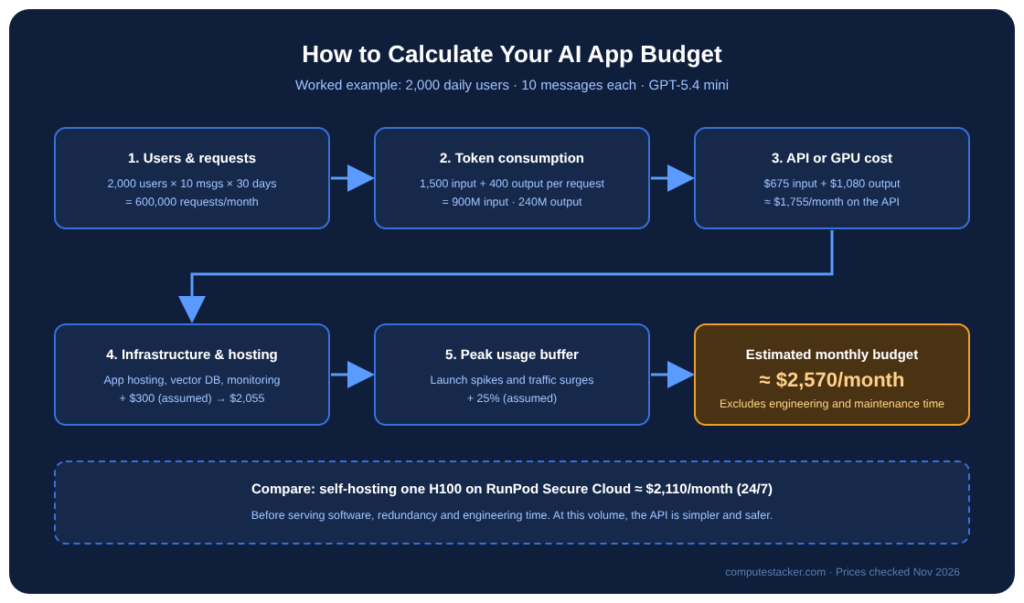
You can estimate monthly costs with five steps. The example uses a customer-support assistant with clearly stated assumptions.
Step 1: Estimate users, requests and tokens
Let’s assume we have 2,000 daily active users that send 10 messages per day. This gives us 600,000 requests per month. Each of those requests would be around 1,500 input tokens and 400 output tokens.
This gives us a total of 900 million input tokens per month, and 240 million output tokens. Input tokens include system prompt, chat history and retrieved documents.
Step 2: Identify API or GPU requirements
For GPT-5.4 mini, the monthly costs would be 900 x $0.75 = $675 for inputs and 240 x $4.50 = $1080 for outputs. This would give a total monthly cost of around $1755.
This would be around $5850 for GPT-5.4. Choosing the right model can easily make the cost 3x more.
Step 3: Calculate infrastructure and hosting
Let’s assume that we pay $300/month to host our application, vector database & monitoring. Obviously this will vary based on your stack, but now our total is around $2055.
Step 4: Add peak usage and overhead
There will be traffic spikes after a launch and marketing efforts. So we’ll add on a 25% buffer to get us around $2,570 per month. On top of this is engineering time for support.
Step 5: Compare against self-hosting
Using 1 H100 instance hosted with RunPod Secure Cloud would cost around $2110 per month to run continuously, however this does not include serving any software, redundancy or engineering time. In this scenario the API would be the easiest and safest option.
As your usage increases you will see self-hosting become more cost effective. We recommend benchmarking your models throughput with your real world traffic first.
How to reduce AI app development and running costs
Most AI apps overspend on a few predictable things. These five habits cut costs without hurting quality.
Choose models based on workload
Not every task needs a flagship model. Route simple tasks like classification or short replies to smaller models. Save the expensive models for complex reasoning.
Optimise GPU utilisation
Idle GPUs burn money. Scale down when traffic drops, and use serverless GPUs for spiky workloads. Spot or interruptible instances suit training jobs that can restart from checkpoints.
Use caching and batching
Prompt caching reduces costs to process repeated prompts, such as long system prompts. Caching the inputs to GPT-5.4 mini costs $0.075 per million tokens to use, which is a massive 90% discount (OpenAI). Batch APIs reduce costs by half to process requests that don’t need instant processing.
Avoid unnecessary infrastructure
Begin with a managed API and an easy backend. Only introduce vector databases, GPUs or fine-tuning when you actually need them. The more components you add the more your monthly bill and maintenance will increase.
Compare GPU cloud providers before committing
The same GPU can cost very different amounts across providers. Check what each rate includes before signing a contract. Our guide on reading GPU pricing pages explains what to look for.
Final thoughts
Whilst your initial investment will be the cost of building your AI application, you’ll likely incur a larger cost as user growth increases token, GPU, and infrastructure costs.
Plan ahead by estimating your monthly traffic, and then multiplying that by current API and GPU rates. Add some extra in there for spikes.
If your app needs GPUs, ComputeStacker lets you compare GPU cloud providers and pricing side by side. A few minutes of comparison can save thousands over a year of running costs.
FAQs
Simple AI applications generally take between two and four months (Groovy Web’s 2026 estimates), mid-complexity applications can take between four and seven months. Complex platforms can take anywhere between seven and twelve months or more.
You’re looking at roughly $0.003 on GPT-5.4 mini for 1,500 input tokens and 400 output tokens. On GPT-5.5 it’s around $0.02. With so many requests, it really adds up.
For many top models, yes. Anthropic’s Opus 4.1 cost $15 input and $75 output per million tokens. Opus 4.6 dropped that to $5 and $25, a 67% cut.
Not if you use a hosted API. The provider runs the GPUs, and you pay per token. You only need GPUs to self-host, fine-tune or train models.
Absolutely! Many teams do this when traffic stabilizes. Build an abstraction layer so you can have one point of provider specific code. Just change the configuration and you’ll be good to go.
Get personalised, no-commitment quotes from top AI infrastructure providers in under 2 minutes.