
On August 26, 2026, AWS and NVIDIA made an extremely large expansion announcement. There would be up to 2 million more GPUs in 2027 and 2028.
This corresponds to 1 million more GPUs, which were already committed for 2026. It is also worth mentioning the framing provided by AWS itself. Indeed, the demand “exceeded expectations” at this scale.
However, we can examine what this deal includes. Is there any change regarding the future supply of GPUs, since prices have already increased on AWS?
Key takeaways
- AWS and NVIDIA added 2 million additional GPUs for 2027-2028, besides 1 million plus GPUs already committed for 2026.
- The demand has exceeded expectations, even before this commitment, according to AWS.
- Moreover, the deal comprised the use of NVIDIA Vera CPUs, NVLink Fusion network, and the allocation of 100,000 GPUs for US government AI factories.
- GPU stock numbers do not equate to the potential deployable capacity because of power and networking restrictions.
- A future increase in supply does not mean a decrease in prices, especially during 2027-2028 when there is a continuous increase in demand.
What AWS and NVIDIA actually announced
However, according to the press release from AWS and NVIDIA, the figure amounts to 2 million additional GPUs. AWS and NVIDIA will introduce these throughout 2027 and 2028.
The AI Compute Threshold Report
We analyzed pricing from 150+ GPU cloud providers to find the exact threshold where an AI startup's OpenAI API bill eclipses the cost of a dedicated H100 cluster.
Read the Full ReportAWS will add these GPUs in addition to the ones it previously announced. At last year’s conference (GTC 2026), AWS and NVIDIA promised more than one million GPUs for deployment in 2026. Independent reporting confirms demand has already exceeded the original commitment.
The additional GPUs include those of the latest generation. This upgrade includes the Blackwell Ultra, Rubin, and Rubin Ultra processors.
However, this deal does not just entail the number of GPUs alone. It also entails NVIDIA’s Vera CPU architecture. In addition, there is also an enhanced NVLink Fusion network layer, which has high-bandwidth memory.
In fact, the team considers the requirements of the governments separately. AWS has reserved 100,000 GPUs specifically for the US government’s AI factories.
This allocation alone merits some reflection. Just two years ago, 100,000 GPUs would have constituted an immense number in itself. Here, however, it is one point in a much larger context.
They have taken hardware for consumers into consideration as well. The new EC2 G7 series will come equipped with NVIDIA’s RTX PRO 4500 Blackwell Server Edition GPUs.
According to AWS, these offer four and six times more AI inference performance than the previous generation of G6 GPUs. They claim the graphics performance increases by 2.1 times.
Why GPU supply isn’t the same as deployable capacity
Two million GPUs is such a huge number. Yes, it is. However, there is a big distinction between chip count and real computing power deployment.
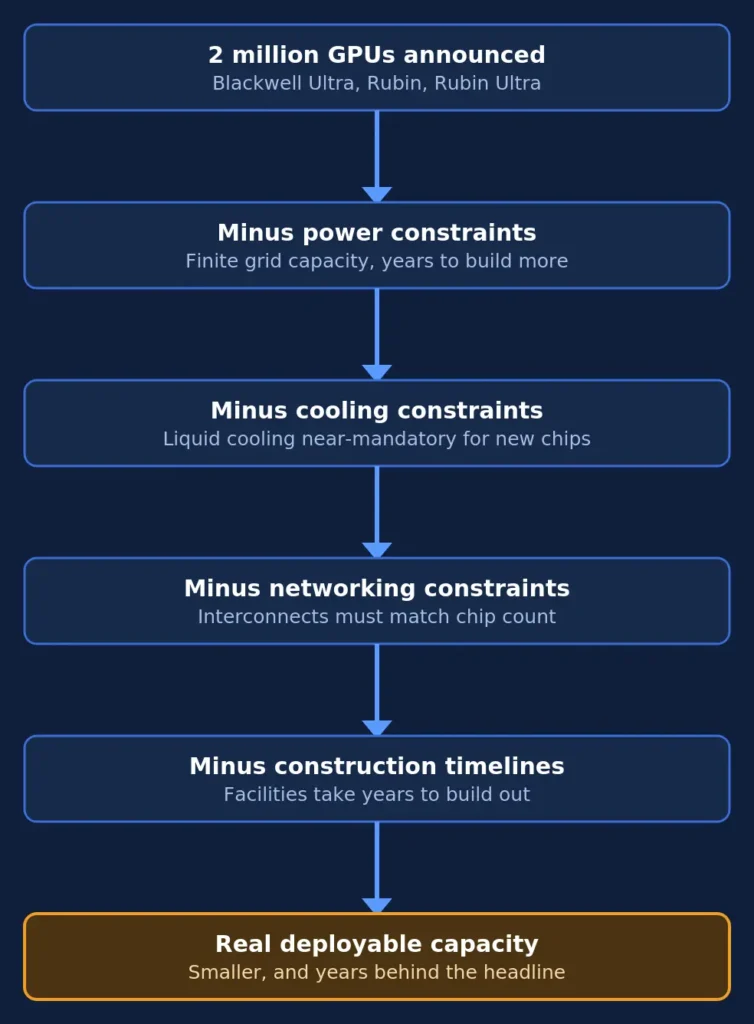
Each chip needs power to run. There is only a certain amount of power provision capacity that data centres can provide, and it takes several years to increase the power provision capacity.
It’s not unique to AWS. In ComputeStacker’s article about the Australia buildout of NVIDIA, we’ve seen the same phenomenon. The actual power requirements of the deployment process underestimated how long it would take to actually deliver capacity.
There’s also the challenge of the cooling required. Today’s GPU clusters produce an insane amount of heat, and they require cooling infrastructure to match. It takes time to build.
Liquid cooling is especially important with the latest generation of GPUs, being almost mandatory for them. The process of converting a building cooled via air into one that uses liquid cooling involves quite a lot of time-consuming effort and isn’t equal to getting some new devices.
We cannot overlook the importance of networking either. It’s the network that allows the AI to learn and infer using the data provided by the GPUs.
That is precisely why the announcement features NVLink Fusion. Otherwise, even if you have enough GPUs, the lack of connection between them will hinder their performance.
Building or rebuilding a data centre to accommodate such hardware requires quite a bit of time. Chip delivery and data centre building schedules may vary.
But none of this makes AWS’s statement meaningless. It’s more about the potential capability than about the availability of 2 million GPUs.
Why more supply doesn’t automatically mean lower prices
And here is the pattern to watch. AWS had already committed to over 1 million GPUs for 2026, yet the demand was greater than that commitment.
The same can easily happen for this new commitment of 2 million GPUs. If the AI compute demand keeps increasing at this speed, this demand will just absorb this additional supply and not lead to any surplus that would push prices lower.
From basic economics, prices drop if the increase in supply exceeds the increase in demand. This is not a case where there is any increase in supply.
The demand for AI compute is outstripping the commitment to supply in 2026.
Timing is also an issue. The increased cost of AWS reservations, which was discussed in ComputeStacker’s AWS pricing section, occurred back in 2026. This was prior to any of the new capacity coming online.
These two are not at odds with each other. AWS has increased its pricing based on the current limited supply while at the same time committing to increase the supply several years in the future.
This does not mean that this announcement will lead to lower prices in 2027. If the rate of demand growth continues at anywhere near the rate seen recently, even 2 million more GPUs may just cover it.
How this connects to AWS’s reservation price hikes
In 2026, AWS increased the prices for EC2 Capacity Blocks twice. The first increase happened in January, approximately by 15%. Followed by a 20% increase in July.
The pricing story and the expansion story are not different stories. These are two perspectives on the same reality: increasing demand for compute power for AI in relation to its supply.
Readers should examine both articles to get the full picture, not each of them separately. What do price increases mean? There is not enough supply at the moment. What does expansion mean? There is an effort to meet the demand.
What AI infrastructure buyers should watch
A few concrete things are worth tracking as this story develops.
Track whether AWS delivers the 2027-2028 capacity on time, as large-scale infrastructure projects are often late for exactly the reasons discussed above regarding electricity, cooling, and building.
Keep a close eye on AWS’s pricing, mainly when Blackwell Ultra and Rubin instances become available. New hardware generations do not debut at a similar cost compared to the hardware they are replacing.
Watch for any pricing guidance from AWS on pricing Capacity Block. Any pricing indicators would certainly change prior to the delivery of the hardware if this supply really affects AWS’s calculations.
In addition, keep an eye out for any moves made by your competitors. Azure and Google Cloud face the same demands that AWS faces. If either one made a similar announcement, that would mean the whole hyperscaler industry believes that there will be demand growth in the future.
In the meantime, the real advice is pretty simple. Don’t rely on this particular announcement to make decisions about needing GPUs right now. A comparison of current rates from verified sources represents the reality of today’s market, not 2027.
Frequently asked questions
What did AWS and NVIDIA actually announce?
A deal for provisioning an additional 2 million GPUs up to 2027 and 2028, in addition to the 1 million GPUs that AWS has reserved for 2026. This agreement covers the provision of CPUs, networking technology, and government capacity requirements.
Will AWS GPU prices go down because of this expansion?
It won’t be arriving anytime soon because the capacity requirements are for 2027-2028. The price increase in 2026 by AWS reflects the current state of supply/demand, which this announcement doesn’t change immediately.
When will the 2 million additional GPUs actually be available?
AWS and NVIDIA’s target dates for deployment are 2027 and 2028. Any large-scale capacity expansions such as this one frequently face delays, so take their target dates as targets, not guarantees.
How does this relate to AWS’s 2026 GPU price increases?
These two market factors interact without contradicting each other. Amazon Web Services increased its reservation prices because of constrained supply and made a commitment to increasing its supply years down the road.
What other infrastructure does this AWS-NVIDIA deal cover?
The contract includes NVIDIA Vera CPU-based infrastructure and NVLink Fusion networking extended layer. In addition, it includes 100,000 GPUs to be supplied to US government AI factories. The new EC2 G7 instances featuring NVIDIA’s RTX PRO 4500 Blackwell Server Edition GPUs complete the list of products.
Is this AWS’s first major GPU commitment with NVIDIA this year?
No, there were previous announcements made about supplying over 1 million GPUs to be deployed by 2026 at GTC 2026. This additional supply of 2 million GPUs to be supplied in 2027-2028 supplements the earlier commitment, but doesn’t substitute it.
The real story is timing, not just scale
Two million additional GPUs is certainly a significant commitment. Moreover, it is a multi-year commitment, not an immediate one.
Announcements about supply changes and pricing changes are two separate events. One of them is a press release. Another one materialises only when engineers ship, install, and operate the hardware.
Prior to 2027 arriving, a more accurate predictor of the GPU market situation would be its current supply and pricing. Learn about current GPU supply and pricing from verified vendors.
Get personalised, no-commitment quotes from top AI infrastructure providers in under 2 minutes.