GPU cloud pricing is the single most important variable determining whether your AI project succeeds or burns through its budget before delivering results. In 2026, the market has matured dramatically since the chaotic supply shortages of 2023 and 2024, but navigating the pricing landscape remains surprisingly complex. Between on-demand rates, reserved instances, spot pricing, egress fees, and storage surcharges, the true cost of renting a GPU in the cloud can differ by as much as 10x depending on the provider you choose and the purchasing model you adopt.
This guide provides a comprehensive, data-backed analysis of GPU cloud costs across every major provider and GPU architecture available in 2026. Whether you are an AI startup founder watching your runway, a machine learning engineer optimizing training budgets, or a CTO evaluating infrastructure partners, this breakdown will equip you with the pricing intelligence you need to make informed decisions and avoid overpaying for compute.
- Specialized GPU cloud providers offer H100 instances at 40-65% lower hourly rates than AWS, Azure, or Google Cloud.
- Spot (interruptible) instances can reduce your compute bill by up to 80%, but require fault-tolerant training pipelines.
- Hidden costs like data egress, NVMe storage tiers, and network bandwidth can add 15-30% to your total bill on hyperscalers.
- The NVIDIA A100 80GB remains the best price-to-performance GPU for most fine-tuning and mid-scale training workloads.
Understanding the GPU Cloud Market Structure
Before comparing raw pricing numbers, it is essential to understand the three tiers of the GPU cloud market, because each tier operates with fundamentally different cost structures and trade-offs.
The AI Compute Threshold Report
We analyzed pricing from 150+ GPU cloud providers to find the exact threshold where an AI startup's OpenAI API bill eclipses the cost of a dedicated H100 cluster.
Read the Full ReportThe first tier consists of the hyperscalers: Amazon Web Services (AWS), Google Cloud Platform (GCP), and Microsoft Azure. These platforms offer massive global infrastructure, deep integration with their proprietary services (S3, BigQuery, Cosmos DB), and enterprise-grade security certifications. However, their GPU pricing reflects the enormous overhead of maintaining this infrastructure. An H100 on AWS costs roughly $12 per GPU per hour on-demand — a premium that many AI-focused teams simply cannot justify.
The second tier comprises specialized GPU cloud providers such as Lambda Labs, CoreWeave, and Voltage Park. These companies have built their entire business around providing AI-optimized compute. They purchase NVIDIA silicon in massive bulk, deploy it in purpose-built data centers with InfiniBand networking, and pass the savings to customers. H100 pricing on these platforms typically ranges from $2.49 to $3.99 per GPU per hour.
The third tier includes decentralized and peer-to-peer networks like Vast.ai, RunPod Community Cloud, and Akash Network. These platforms aggregate idle GPU capacity from independent data centers and individual hardware owners. Pricing can drop as low as $0.15 per hour for consumer-grade GPUs like the RTX 3090, making them invaluable for budget-constrained research and experimentation.
NVIDIA H100 Pricing Across Providers (2026)
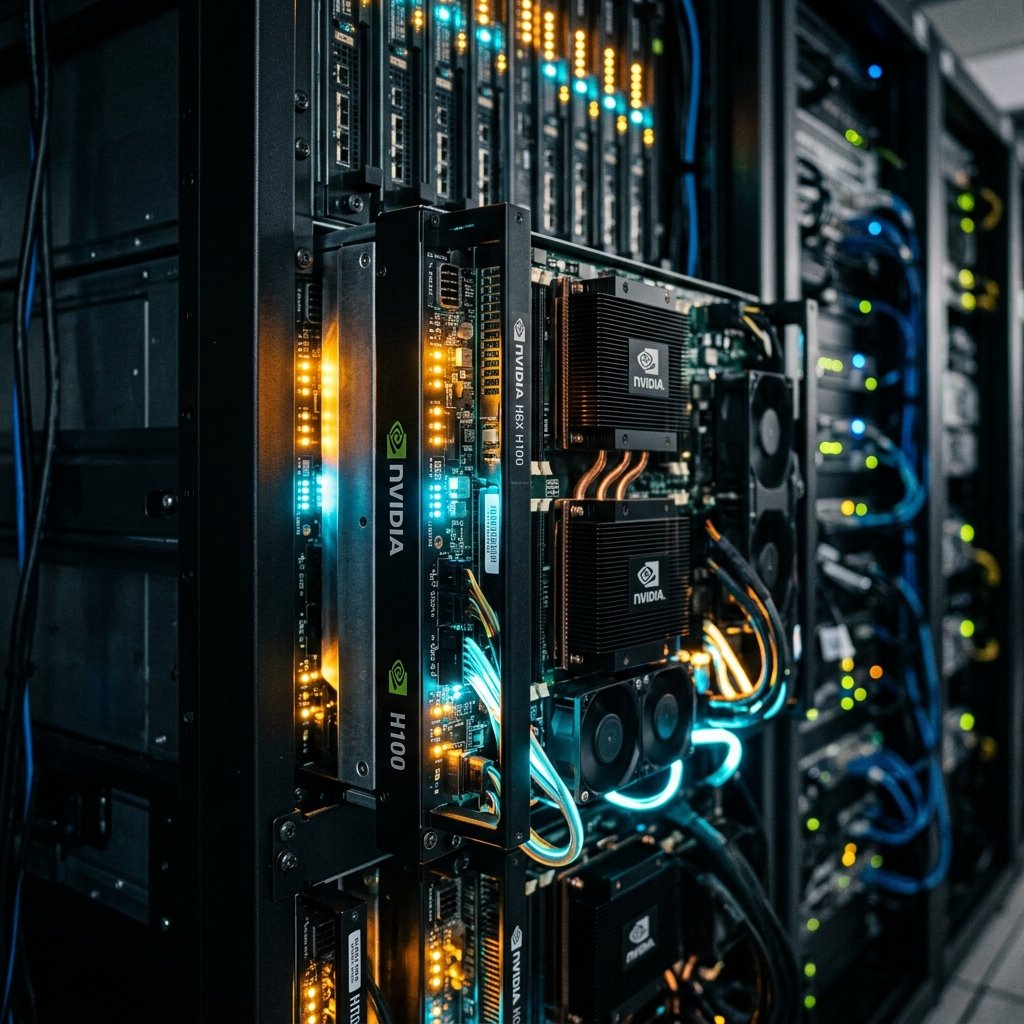
The NVIDIA H100 Tensor Core GPU remains the gold standard for large-scale AI training. Its 80GB of HBM3 memory, FP8 Transformer Engine, and 3.35 TB/s memory bandwidth make it essential for training models larger than 30 billion parameters. Here is how pricing compares across the major providers in April 2026:
| Provider | GPU Config | On-Demand ($/GPU/hr) | Reserved ($/GPU/hr) | Spot ($/GPU/hr) |
|---|---|---|---|---|
| AWS (p5.48xlarge) | 8x H100 SXM5 | $12.29 | $7.25 (1yr) | ~$5.50 |
| Google Cloud (a3-highgpu) | 8x H100 | $11.56 | $7.80 (1yr) | ~$4.90 |
| CoreWeave | 8x H100 SXM5 | $3.99 | $3.09 (6mo) | N/A |
| Lambda Labs | 1x H100 SXM5 | $3.49 | $2.99 (3mo) | N/A |
| RunPod | 1x H100 PCIe | $3.29 | N/A | $1.99 |
| FluidStack | 1x H100 SXM5 | $2.49 | $2.19 (3mo) | N/A |
The pricing gap between hyperscalers and specialized providers is staggering. For a startup running a 30-day continuous training job on 8 H100 GPUs, the cost difference between AWS on-demand and Lambda Labs amounts to approximately $50,000 per month. Over a year, that difference exceeds half a million dollars — enough to fund an entire engineering team. Compare all GPU cloud providers on ComputeStacker to see live pricing.
NVIDIA A100 and Mid-Tier GPU Pricing
While the H100 dominates headlines, the NVIDIA A100 80GB remains the workhorse of the industry for fine-tuning, inference, and training models under 30 billion parameters. Its mature software ecosystem, excellent PyTorch compatibility, and significantly lower hourly rate make it the pragmatic choice for budget-conscious teams.
A100 80GB pricing in 2026 has stabilized around $1.79 to $2.49 per hour on specialized providers. On AWS (p4de instances), the same GPU costs approximately $5.12 per hour on-demand. For teams running inference workloads that do not require the H100’s FP8 capabilities, the A100 delivers roughly 85% of the performance at 55% of the cost — an extraordinary value proposition.
Beyond the A100, the NVIDIA L40S and RTX 6000 Ada have emerged as compelling options for inference-heavy deployments. The L40S, with 48GB of GDDR6X memory, costs approximately $1.29 per hour on providers like Cudo Compute and is particularly well-suited for serving medium-sized language models and running Stable Diffusion XL inference at scale.
The Hidden Cost Multipliers
Raw GPU hourly pricing tells only part of the story. Experienced infrastructure engineers know that the total cost of ownership (TCO) includes several hidden multipliers that can inflate your bill by 15-30% beyond the advertised compute rate.
Data Egress Fees
Hyperscalers charge between $0.08 and $0.12 per gigabyte for data leaving their network. If you are training on AWS but need to export model checkpoints, evaluation results, or tensorboard logs to an external system, these costs accumulate rapidly. Moving a 10TB dataset out of AWS S3 costs approximately $900. Specialized providers like Lambda Labs and CoreWeave typically offer free or heavily subsidized egress, making them far more suitable for multi-cloud architectures.
High-Performance Storage
Saturating an H100 GPU requires feeding it data at extraordinary speeds. Standard cloud object storage (like S3 or GCS) cannot deliver the IOPS required for large-scale training. You need NVMe-backed parallel file systems (WEKA, Lustre, or VAST Data). On hyperscalers, provisioning high-IOPS SSD storage adds $0.10 to $0.25 per GB per month. For a training dataset of 5TB, that is an additional $500 to $1,250 per month in storage costs alone.
Network Bandwidth for Multi-Node Training
When training across multiple nodes (more than 8 GPUs), the network interconnect becomes critical. NVIDIA InfiniBand NDR at 400 Gbps is the industry standard for minimizing gradient synchronization latency. Some providers include InfiniBand in their pricing; others charge a premium. Always confirm whether the quoted GPU price includes dedicated InfiniBand ports, or whether network bandwidth is metered separately.
Spot vs. On-Demand vs. Reserved: Choosing the Right Model
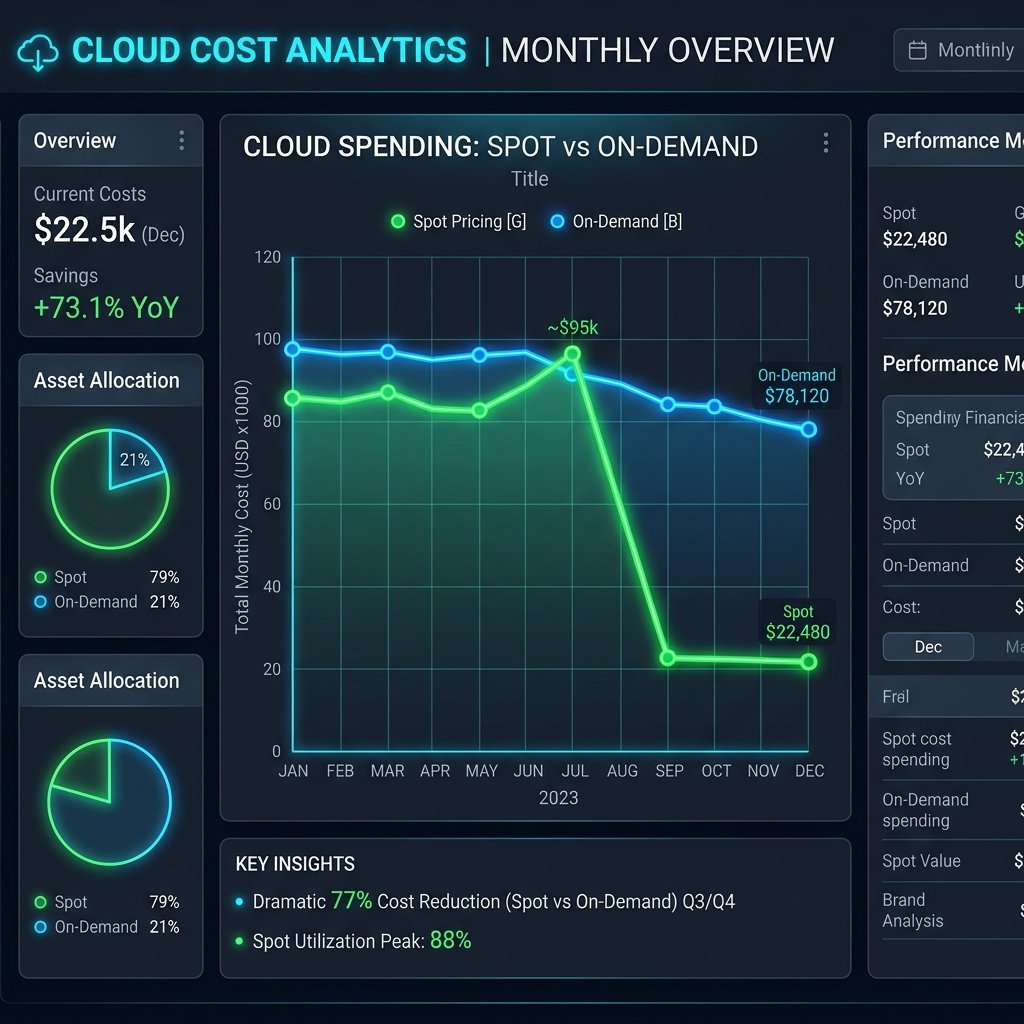
The pricing model you select can reduce your costs by up to 80%, but each model carries distinct trade-offs that must align with your workload characteristics.
On-Demand Instances
On-demand pricing is the simplest model: you pay a fixed hourly rate for guaranteed access to a GPU for as long as you need it. There is no commitment, no contract, and no risk of interruption. This model is ideal for production inference endpoints, time-sensitive training runs, and workloads where downtime is unacceptable. However, it is also the most expensive option. On-demand should be your default only when reliability is more important than cost.
Reserved Instances
Reserved pricing requires committing to a specific GPU configuration for a fixed period — typically 1, 3, 6, or 12 months. In exchange, providers offer discounts of 15-40% compared to on-demand rates. CoreWeave offers 6-month reserved H100 contracts at approximately $3.09 per GPU per hour, compared to $3.99 on-demand. For teams with predictable, continuous compute needs (such as running a production inference cluster 24/7), reserved instances are almost always the optimal choice. The risk is that if your compute needs change mid-contract, you are locked into paying for capacity you may not use.
Spot (Interruptible) Instances
Spot instances represent excess capacity that providers sell at steep discounts with the caveat that they can reclaim the GPU at any time, typically with 30 to 120 seconds of warning. Spot pricing for H100 GPUs can drop to $1.50 to $2.50 per hour — a 40-60% discount over on-demand. For workloads that checkpoint frequently (such as pre-training with automatic resume logic), spot instances are the most cost-effective compute available anywhere. The engineering investment required to build robust checkpoint-and-resume pipelines pays for itself within a single multi-week training run.
Cost Optimization Strategies for AI Teams
Beyond selecting the right provider and pricing model, several tactical strategies can further reduce your GPU cloud spend:
- Mixed-precision training: Using BF16 or FP8 (on H100s) instead of FP32 roughly doubles your training throughput without meaningful accuracy loss, effectively halving your compute cost per epoch.
- Gradient accumulation: Simulating larger batch sizes without requiring additional GPUs reduces the number of nodes needed for distributed training.
- Data pipeline optimization: Ensuring your CPU data loading pipeline can saturate the GPU prevents expensive idle time. Use NVIDIA DALI or WebDataset for high-throughput data ingestion.
- Right-sizing GPU selection: Not every workload needs an H100. Fine-tuning a 7B model with LoRA runs perfectly on an RTX 4090 at $0.39 per hour — 10x cheaper than an H100. Match the GPU to the task.
- Multi-cloud arbitrage: Monitoring pricing across multiple providers and shifting workloads to the cheapest available option at any given time. Tools like SkyPilot automate this process.
For a detailed walkthrough of choosing the right provider for your specific workload, explore our provider comparison tool or browse GPU types and specifications to match hardware capabilities to your model architecture.
What to Expect in Late 2026 and Beyond
Several market dynamics will continue reshaping GPU cloud pricing through the remainder of 2026 and into 2027. The launch of NVIDIA Blackwell (B200) GPUs is expected to push H100 pricing down further as supply increases and demand shifts toward the newer architecture. AMD’s MI300X continues to gain traction as a viable alternative, particularly for inference workloads, and its competitive pricing is forcing NVIDIA partners to sharpen their rates. Additionally, the growing maturity of custom silicon (Google TPUs, AWS Trainium) is creating downward pricing pressure across the entire accelerator market.
For AI teams, this means that locking into excessively long reserved contracts (beyond 6 months) carries increasing risk. The hardware landscape is evolving rapidly, and pricing will almost certainly be lower in 12 months than it is today. A prudent strategy is to commit to 3-month reserved periods for predictable workloads and use on-demand or spot for everything else.
Frequently Asked Questions
Why is AWS so much more expensive for GPU compute than Lambda Labs or CoreWeave?
AWS bundles massive global infrastructure, proprietary networking (Nitro system), enterprise security certifications (FedRAMP, HIPAA), and deep service integrations into their pricing. Specialized providers strip away this overhead, focusing purely on bare-metal GPU performance for AI workloads and passing the savings to customers. For teams that only need compute power without the broader AWS ecosystem, the specialized providers deliver identical hardware at 40-65% lower cost.
Are spot GPU instances reliable enough for production training?
Spot instances are reliable enough for training if your pipeline is built for fault tolerance. This means implementing automatic checkpointing every 15-30 minutes, using training frameworks that support elastic scaling (like DeepSpeed or PyTorch Elastic), and scripting automatic job resumption when a new spot instance becomes available. Many well-funded AI labs run their entire pre-training pipeline on spot instances, saving millions of dollars annually.
Is it cheaper to buy GPUs outright or rent them from the cloud?
For sustained 24/7 usage over 18+ months, purchasing hardware typically becomes cost-effective. An H100 SXM5 GPU costs approximately $30,000 to purchase. Renting one at $3.00 per hour costs roughly $26,000 per year. However, ownership adds electricity costs ($3,000-5,000 per GPU per year), cooling infrastructure, maintenance staff, and depreciation risk as newer GPUs launch. For most teams, cloud rental remains more cost-effective unless utilization exceeds 80% continuously for more than two years.
What is the cheapest GPU cloud option for fine-tuning in 2026?
For fine-tuning workloads using LoRA or QLoRA, the cheapest viable option is renting an RTX 4090 (24GB VRAM) on RunPod Community Cloud or Vast.ai for approximately $0.25-0.40 per hour. This hardware is sufficient for fine-tuning models up to 13B parameters. For larger models requiring 80GB VRAM, the NVIDIA A100 on FluidStack at approximately $1.79 per hour offers the best price-to-performance ratio.
Get personalised, no-commitment quotes from top AI infrastructure providers in under 2 minutes.