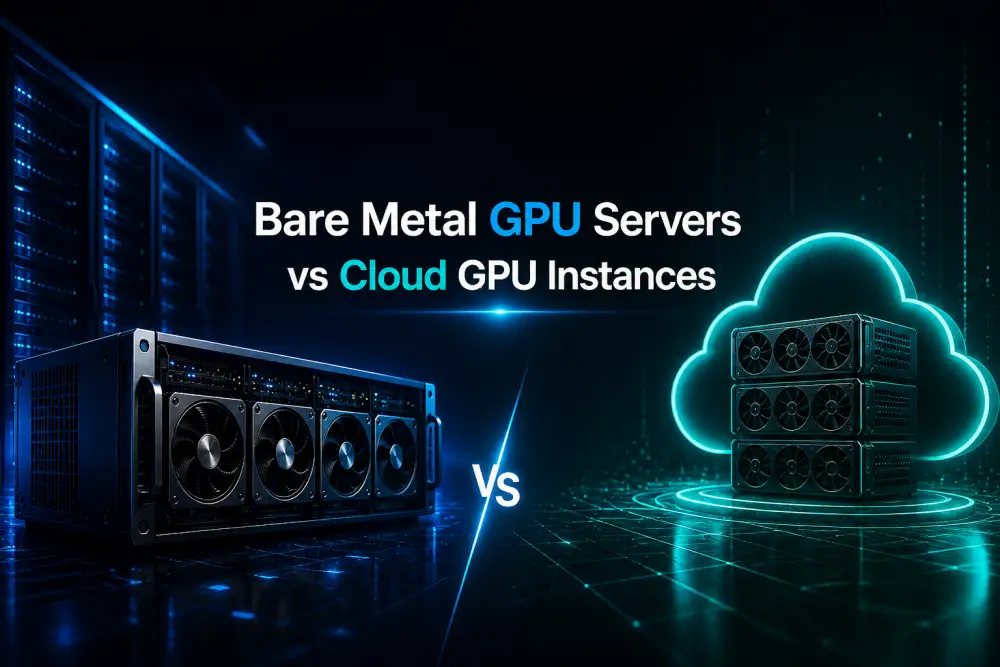
Every AI team eventually hits the same fork in the road: do you rent GPU instances from a public cloud, or do you lease dedicated bare metal servers? The answer is not as obvious as either side wants you to believe. I have worked with teams that saved 60% by moving to bare metal — and teams that wasted six figures on dedicated hardware they could not fully utilize.
This guide walks through the real economics, the hidden costs nobody talks about, and a practical framework for deciding which approach fits your workload profile.
What Are We Actually Comparing?
First, let us define our terms precisely, because “bare metal” and “cloud” mean different things to different people.
Cloud GPU Instances
These are virtualized or semi-virtualized GPU resources from providers like AWS (p5 instances), Google Cloud (A3 VMs), Azure (ND-series), CoreWeave, Lambda Cloud, and dozens of smaller providers. You pay per hour or per second, spin instances up and down as needed, and share the underlying physical infrastructure with other tenants.
The AI Compute Threshold Report
We analyzed pricing from 150+ GPU cloud providers to find the exact threshold where an AI startup's OpenAI API bill eclipses the cost of a dedicated H100 cluster.
Read the Full ReportThe key advantages: elasticity (scale from 1 GPU to 1,000 in minutes), zero ops overhead (the provider handles hardware failures, networking, and cooling), and no commitment (test a configuration for an hour and walk away).
Bare Metal GPU Servers
Bare metal means you lease an entire physical server — typically with 4x or 8x GPUs, dedicated CPUs, NVMe storage, and exclusive network bandwidth. Nobody else runs workloads on your hardware. Providers like Hetzner, OVHcloud, Vultr, Latitude.sh, and specialized GPU hosts like TensorDock and Shadeform offer these.
Bare metal commitments usually range from monthly to annual contracts. You get full root access, no hypervisor overhead, and predictable performance — but you are responsible for the software stack, monitoring, and utilization efficiency.
The Cost Comparison Everyone Gets Wrong
The most common mistake in this comparison is looking at hourly rate alone. A cloud H100 at $3.00/hr seems expensive compared to a bare metal 8x H100 server at $15,000/month. But do the math carefully.
Cloud GPU Economics
Scenario: AI team running training jobs 8 hours/day, 5 days/week
- 8x H100 cloud instance: $24.00/hr × 8 hours × 22 days = $4,224/month
- You pay only for what you use
- Zero cost during nights, weekends, and between experiments
- No ops staff needed for hardware management
Bare Metal Economics
Same team, dedicated 8x H100 server:
- Monthly lease: $14,000-18,000/month (varies by provider and commitment length)
- The server runs 24/7 whether you use it or not
- Effective hourly rate at 40 hours/week utilization: $18,000 ÷ 160 hours = $112.50/hr
- Effective hourly rate at 24/7 utilization: $18,000 ÷ 720 hours = $25.00/hr
The crossover point is clear: bare metal becomes cheaper when your GPU utilization exceeds approximately 55-60% of total available hours. Below that, you are paying for idle hardware.
Hidden Costs of Bare Metal That Nobody Mentions
The monthly lease is not your only cost. Teams that move to bare metal without accounting for these line items consistently underestimate their TCO by 25-40%:
1. Engineering Ops Time
Someone needs to manage CUDA drivers, container orchestration, job scheduling, monitoring, and failure recovery. On a public cloud, this is handled for you. On bare metal, budget 0.25-0.5 FTE of an ML infrastructure engineer. At a fully loaded cost of $180K-250K/year, that is $45K-125K in annual overhead.
2. Network Egress and Storage
Most bare metal providers charge separately for bandwidth and additional storage. Training datasets often run 500GB-5TB. Moving data in and out — especially across regions — adds $200-2,000/month depending on volume.
3. Idle Waste
This is the silent killer. Unless your team runs training jobs 24/7 with near-perfect scheduling, you will have idle periods. A server sitting idle at 3 AM still costs the same as one running a training job. Most teams we talk to achieve 40-65% utilization on bare metal — meaning 35-60% of their spend is pure waste.
4. Failure and Downtime Risk
GPU hardware fails. NVMe drives die. Power supplies trip. On a public cloud, the provider swaps hardware transparently and often migrates your workload. On bare metal, you file a support ticket and wait — sometimes hours, sometimes days. Every hour of downtime during a critical training run has an opportunity cost.
Hidden Costs of Cloud GPU That Nobody Mentions
Fair is fair — cloud is not all sunshine either:
1. Spot Instance Volatility
Many teams plan budgets around spot pricing ($1.50-2.00/hr for H100s), but spot instances get preempted. A training run interrupted at 80% completion wastes the entire cost of the first 80%. Without robust checkpointing, spot instances can actually be more expensive than on-demand.
2. Data Transfer Lock-In
Once your training data lives in a specific cloud’s object storage, moving it out is expensive. AWS charges $0.09/GB for egress. A 2TB dataset costs $180 just to download. This creates soft lock-in that makes switching providers painful.
3. Noisy Neighbor Effects
On virtualized GPU instances, other tenants sharing the same physical host can impact your network throughput and storage I/O. This is less of an issue with dedicated GPU instances (like AWS p5 or CoreWeave’s bare-metal-like VMs), but it is real on shared-tenancy platforms.
When to Choose Cloud GPU Instances
Cloud GPUs are the right choice when:
- Your workloads are bursty. Training runs that last 2-48 hours followed by days of analysis and iteration. You should not pay for idle GPUs during the analysis phase.
- You are a small team (under 5 ML engineers). The ops overhead of managing bare metal servers eats into your capacity to do actual ML work.
- You need multi-region deployment. Inference endpoints that serve users in the US, EU, and Asia simultaneously. No bare metal provider matches the geographic reach of AWS, GCP, or Azure.
- You are in the experimentation phase. Testing different GPU types, model architectures, and hyperparameters. Cloud elasticity lets you run 10 experiments in parallel on different hardware.
- Compliance requirements dictate specific clouds. If your enterprise requires SOC 2 Type II, HIPAA, or FedRAMP, major clouds have these certifications. Most bare metal providers do not.
When to Choose Bare Metal GPU Servers
Bare metal wins when:
- You have continuous, predictable workloads. If your GPUs are running training or inference 18+ hours/day, 7 days/week, bare metal’s fixed cost becomes dramatically cheaper than per-hour cloud pricing.
- You are serving high-volume inference. Production inference endpoints that handle thousands of requests per second need dedicated, predictable hardware. The performance consistency of bare metal is valuable here.
- Data sovereignty requires physical control. Some industries (defense, healthcare, financial services) require knowing exactly where their data sits — down to the specific rack in a specific data center.
- You need deep hardware customization. Custom networking topologies, specific NVMe configurations, or non-standard GPU-to-CPU ratios. Cloud providers offer fixed instance types; bare metal lets you configure exactly what you need.
- Your team has infrastructure expertise. If you already have DevOps/SRE engineers who can manage Kubernetes, Slurm, or custom job schedulers, the ops overhead of bare metal is manageable.
The Hybrid Approach: Best of Both Worlds
The smartest teams I work with do not pick one or the other — they use both strategically:
- Bare metal for steady-state workloads: Production inference, nightly retraining jobs, and long-running experiments that run 24/7.
- Cloud for burst capacity: Hyperparameter sweeps, one-off experiments, and peak traffic handling. Scale up for a few hours, then shut down.
This hybrid model can reduce total GPU spend by 40-50% compared to going all-cloud, while avoiding the utilization trap of going all-bare-metal.
How to Find the Right Provider
Both cloud GPU and bare metal providers vary wildly in pricing, availability, and quality. Use ComputeStacker’s provider directory to compare options side by side — filter by GPU type, region, pricing model, and commitment length to find the configuration that matches your team’s workload profile and budget.
The right infrastructure choice is not about ideology. It is about matching your utilization pattern, team size, and workload characteristics to the economic model that minimizes your cost per unit of useful AI compute.
Get personalised, no-commitment quotes from top AI infrastructure providers in under 2 minutes.