Here’s the brutal truth about building an AI startup right now: your biggest existential threat isn’t your competition. It’s your infrastructure bill.
We see it happen a hundred times a month. An engineering team builds a brilliant RAG pipeline or an autonomous agent. They hook it up to OpenAI or Anthropic because it’s easy. It’s frictionless. The prototype works beautifully.
Then, the product goes viral.
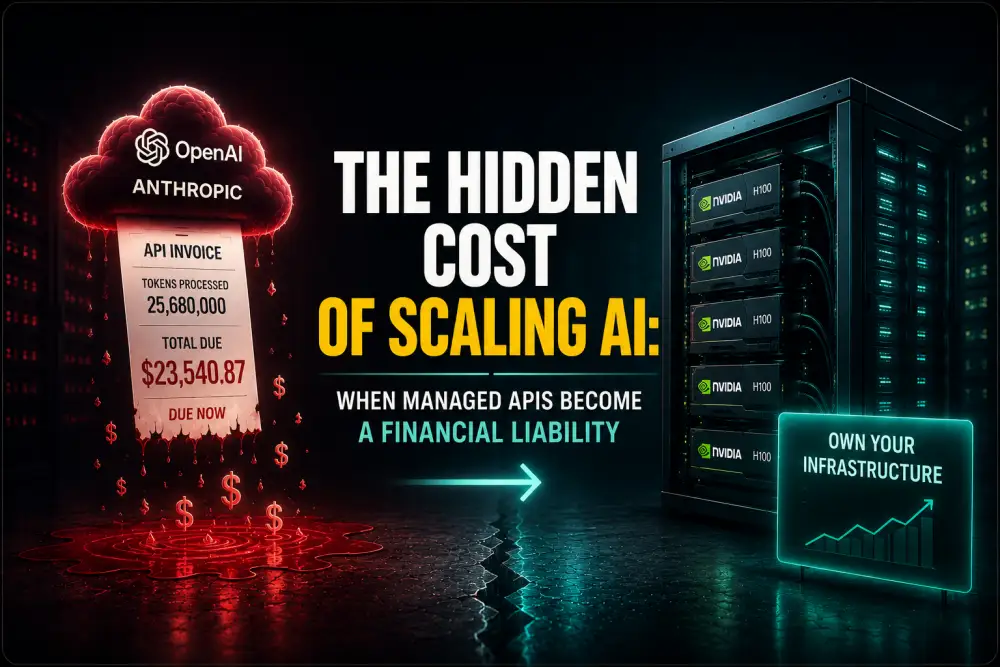
Suddenly, you are processing millions of tokens a day. And what felt like a negligible API cost during testing abruptly explodes into a five-figure monthly invoice that is actively destroying your gross margins.
The AI Compute Threshold Report
We analyzed pricing from 150+ GPU cloud providers to find the exact threshold where an AI startup's OpenAI API bill eclipses the cost of a dedicated H100 cluster.
Read the Full ReportThis is the “Success Penalty.” And if you don’t recognize when you are crossing the threshold, it will kill your runway.
The API Convenience Trap
Managed APIs like GPT-4o and Claude 3.5 Sonnet are modern miracles. They allow tiny teams to build world-class intelligence without knowing a single thing about CUDA kernels or tensor parallelism.
But that convenience has a massive markup.
When you pay for an API, you aren’t just paying for the compute. You are paying for the massive overhead, the ultra-low latency guarantees, the R&D, and the incredible profit margins of the provider.
For low-volume, highly complex queries, this trade-off makes perfect sense. But the moment your application scales—especially for high-volume, repetitive tasks like data extraction, summarization, or background agents—that variable cost structure becomes toxic.
Scaling AI infrastructure costs linearly when using APIs. But the revenue of most SaaS companies does not scale linearly with usage.
If a user pays you a flat $20/month subscription, but they run your AI feature 500 times a day, you are losing money on every single interaction.
The Compute Poverty Line
At what exact point does the math break? When does it become financially irresponsible to keep paying per-token?
We decided to stop guessing and actually map the math.
Our team analyzed pricing data across more than 150 global GPU cloud providers. We compared the spot and reserved pricing of dedicated NVIDIA H100s against the blended token costs of the major API providers. We factored in the cost of hiring a dedicated MLOps engineer to maintain an open-source model like Llama 3 70B.
We found the exact crossover point. We call it the AI Compute Threshold.
Once your application processes between 12M and 25M tokens per day, the math permanently inverts. Past this threshold, your API bill mathematically overtakes the total cost of leasing a dedicated H100 GPU cluster and paying an engineer to manage it.
Recognizing the Transition
Transitioning from managed APIs to self-hosted GPUs isn’t just about throwing hardware at the problem. It requires a fundamental shift in how your engineering team operates.
But ignoring the math isn’t an option.
If your token volume is climbing, you need to be actively planning your escape route. You need to understand the difference between inference endpoints, spot instances, and long-term bare-metal leases.
Start by looking at your current daily token volume. Look hard at your AWS or OpenAI invoice.
If you are anywhere near that 15M daily token mark, you are bleeding cash.
Stop overpaying for compute. Read our full analysis in the AI Compute Threshold Report to see the exact cost curves, understand the economics of the transition, and take our Readiness Diagnostic to see if your team is prepared to make the switch.
Get personalised, no-commitment quotes from top AI infrastructure providers in under 2 minutes.