In the AI infrastructure space, there is an absurd amount of noise and very little signal.
Every day, another startup claims they can “cut your inference costs by 90%.” Every week, a new API provider tweaks their pricing by fractions of a cent per million tokens.
But for founders and CTOs trying to plan their runway, abstract promises are useless. They need hard numbers. They need to know exactly when it makes economic sense to stop renting APIs and start leasing bare metal.
So, we built the signal.
The AI Compute Threshold Report
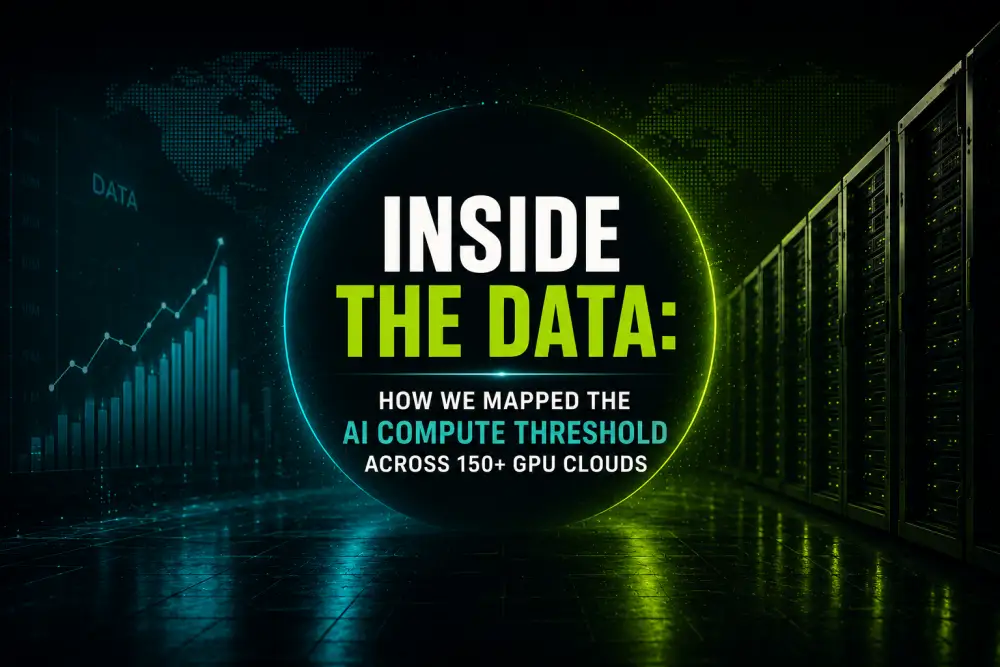
We analyzed pricing from 150+ GPU cloud providers to find the exact threshold where an AI startup's OpenAI API bill eclipses the cost of a dedicated H100 cluster.
Read the Full ReportWe just released the AI Compute Threshold Report, the most comprehensive pricing analysis of the GPU cloud market ever published. Here is a behind-the-scenes look at how we mapped the transition point for modern AI startups.
The Methodology: Tracking 150+ Providers
ComputeStacker is in a unique position. Because we operate the world’s largest index of GPU cloud providers, we have unprecedented visibility into the actual, live market rates for enterprise compute.
To build this report, we didn’t just look at AWS, Azure, and Google Cloud. That’s not where the innovation is happening.
We ingested pricing data from over 150 specialized GPU cloud providers—from massive Tier 2 hyperscalers to boutique bare-metal hosts in Iceland running on 100% geothermal energy.
We focused specifically on the NVIDIA H100 80GB SXM5, as it is the undisputed workhorse for modern LLM training and high-throughput inference. We aggregated both Spot (on-demand) and Reserved (long-term commit) pricing to find the true market averages.
The API Comparison
Knowing the cost of a GPU is only half the equation. We had to map that against the cost of the status quo: managed APIs.
We calculated a blended cost-per-million tokens for the industry leaders: OpenAI (GPT-4o) and Anthropic (Claude 3.5 Sonnet).
But we didn’t stop at hardware vs. API. The biggest mistake analysts make is ignoring human capital. Self-hosting an open-source model like Llama 3 requires an engineer. We factored in the fully-loaded cost of a senior MLOps engineer ($200k+/year) into the “self-hosted” equation. We wanted to find the threshold where leasing GPUs and hiring a human was still cheaper than paying OpenAI.
The 15M Token Shock
We expected the crossover point to be high. We were wrong.
When we plotted the logarithmic cost curves, the exact point of intersection—the AI Compute Threshold—was shockingly low.
Between 12M and 25M tokens processed per day.
If an AI application is processing more than 15M tokens daily, the API pricing model mathematically breaks. The startup is officially losing money by not migrating to dedicated infrastructure.
This isn’t a theory. It is a mathematical certainty based on current market rates.
If you are scaling an AI product, you cannot afford to ignore this data. Dive into the full methodology, explore the interactive cost curves, and see where your startup sits on the spectrum.
Read the full analysis here: The AI Compute Threshold Report.
Get personalised, no-commitment quotes from top AI infrastructure providers in under 2 minutes.