For European AI teams, choosing a GPU cloud provider isn’t just a performance and cost decision — it’s a legal one. GDPR places strict obligations on where European user data can be processed and stored, and the fines for non-compliance aren’t theoretical: the EU has levied over €4.5 billion in GDPR fines since 2018.
Yet most GPU cloud comparison guides treat the EU market as an afterthought. This guide doesn’t. Here’s everything European AI teams need to know about running GDPR-compliant AI workloads in the cloud in 2026.
What GDPR Actually Requires for AI Compute
GDPR doesn’t prohibit training AI models — but it does govern how personal data in training datasets is handled. The key requirements:
- Data residency: Personal data about EU residents must be processed and stored within the EEA, or under an adequacy decision or Standard Contractual Clauses (SCCs) if transferred outside.
- Data Processing Agreements (DPAs): If you use a cloud provider to process personal data, you must have a DPA in place with them. Any provider operating in the EU must offer this.
- Data minimization: Only the personal data actually necessary for training should be used. Implementing proper data anonymization or synthetic data pipelines is strongly recommended.
- Right to erasure: If a user requests deletion of their data, you need a documented process to remove their data from training datasets and potentially retrain affected models.
If your training data contains no personal data (purely technical datasets, synthetic data, public web crawls with proper filtering), GDPR requirements are significantly lighter. But if you’re training on user interactions, customer records, or any data tied to identifiable individuals, the above applies in full.
EU-First GPU Cloud Providers in 2026
Not all GPU cloud providers are equal on GDPR compliance. Here are the providers with genuine EU-first infrastructure:
Genesis Cloud — Best for EU Data Sovereignty
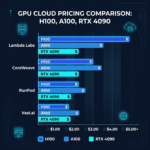
Genesis Cloud is built specifically for the European market, with data centers in Iceland, Norway, Germany, and the Netherlands. All infrastructure stays within the EEA. They offer Standard Contractual Clauses, Data Processing Agreements, and ISO 27001 certification out of the box. Prices are genuinely competitive: RTX 4090 from €0.70/hr, A100 80GB from €2.60/hr.
Cudo Compute — Best for Sustainable EU AI
Cudo Compute runs data centers in the UK, Norway, and Germany on 100% renewable energy. Their European infrastructure is GDPR-compliant, and they provide DPAs for all EU customers. Uniquely, Cudo also offers verified carbon-neutral compute — important for EU companies with sustainability reporting requirements under CSRD.
FluidStack — Best Enterprise EU Option
FluidStack’s UK and EU Central (Germany, France) infrastructure provides enterprise-grade H100 and A100 clusters for European teams. They’re ISO 27001 certified and have SOC 2 in progress. For enterprise teams needing dedicated H100 cluster capacity in the EU, FluidStack is among the best options available.
Lambda Labs (EU Region)
Lambda Labs operates a UK region, which post-Brexit falls under UK GDPR (which largely mirrors EU GDPR). Data processed in Lambda’s UK region stays in the UK. For companies needing strict EU residency (within the EEA), Genesis Cloud or Cudo are better choices.
The Schrems II Problem and SCCs
After the Schrems II ruling in 2020, data transfers to the US are no longer automatically permitted under the EU-US Privacy Shield. The replacement framework (the EU-US Data Privacy Framework, approved in 2023) provides some protection, but remains under legal challenge.
For AI teams processing sensitive personal data, the safest approach remains using infrastructure physically located within the EEA under SCCs or an adequacy decision, rather than relying on US-based providers claiming Privacy Framework compliance.
The Business Case for EU-Based AI Compute
Beyond compliance, EU-based GPU cloud has a compelling business case in 2026:
- Lower latency for EU users: Inference models hosted in the EU deliver 30-60ms lower latency to EU end users vs US-hosted alternatives — meaningful for real-time applications.
- Carbon reporting: EU companies under CSRD must report Scope 3 emissions. Providers offering renewable energy (Genesis Cloud, Cudo Compute) simplify this reporting.
- Customer trust: “EU-hosted and GDPR-compliant” is increasingly a selling point for B2B SaaS companies with EU enterprise customers.
- Regulatory future-proofing: The EU AI Act (fully effective 2025-2026) adds additional requirements for high-risk AI systems. EU-based providers are more likely to have aligned compliance infrastructure.
Practical GDPR Compliance Checklist for AI Teams
- Audit your training datasets for personal data — pseudonymize or remove it where not essential
- Select a GPU cloud provider with EEA-based data centers and a signed DPA
- Verify the provider’s ISO 27001 or equivalent certification
- Document your lawful basis for processing any personal data in AI training
- Implement checkpoint and model version control to support data deletion requests
- Review your inference deployment for any personal data processing at inference time
Looking for EU-compliant GPU cloud providers? Browse providers by European region on ComputeStacker — filter by UK, Germany, Netherlands, and Nordic regions. You can also compare EU providers side by side on pricing and compliance certifications, or request quotes specifically from EU-based providers.
Frequently Asked Questions
Is it GDPR-compliant to train AI models on AWS or Google Cloud?
It can be, but requires careful configuration. AWS and Google Cloud offer EU-region data centers and sign Data Processing Agreements. Training personal data must be processed exclusively in EU regions with data residency controls enabled. However, for maximum legal certainty, EU-native providers like Genesis Cloud or Cudo Compute operating solely within the EEA eliminate the cross-border transfer complexity entirely.
Which EU GPU cloud providers have ISO 27001 certification?
As of 2026, Genesis Cloud and FluidStack hold ISO 27001 certification. Cudo Compute operates under equivalent frameworks with SOC 2 and GDPR-specific controls. Always request current certification documentation from any provider before processing personal data under GDPR.
Get personalised, no-commitment quotes from top AI infrastructure providers in under 2 minutes.